

The Real Cost of Building HIPAA-Compliant AI Agents in 2026: Budget, Compliance, Architecture & ROI
Healthcare organizations are moving beyond AI experiments.
What started as simple chatbots and documentation tools is turning into AI agents that can
schedule appointments, summarize patient encounters, assist with clinical workflows, answer
insurance questions, retrieve information from electronic health records, and support care teams
throughout the day.
Recent healthcare industry research found that about half of surveyed U.S. healthcare organizations have already implemented generative AI, while more than 80% have deployed at least one use case to end users. The conversation is no longer about whether AI belongs in healthcare. The conversation is about how to build it safely, connect it to existing systems, and justify the investment.
For early-stage founders, the bigger question is often whether AI should be included in version one at all. Before budgeting for healthcare AI, it is worth evaluating how to integrate it without adding unnecessary operational friction. Our framework on Does Your Startup Need AI in 2026? provides a highly practical starting point for defining your core product scope.
Unfortunately, many healthcare founders dramatically underestimate costs when attempting to manage architecture on their own. Rushing into coding without validating healthcare compliance workflows is exactly Why Adding AI Too Early Can Slow Your Startup’s Growth. The risk isn't the AI technology itself; it's the execution strategy. By partnering with a specialized development team early on, you can validate your workflows during product discovery, saving tens of thousands in development waste.
A startup may budget $30,000 for an AI chatbot only to discover later that security reviews, EHR integrations, audit logging, encryption requirements, cloud infrastructure, consent management, and compliance documentation cost more than the chatbot itself. This is why sophisticated healthcare startups bypass generic software agencies and work with specialized healthcare development partners like Budventure to map out compliance and infrastructure frameworks before writing a single line of code.
A HIPAA-compliant AI agent is not simply an interface connected to a large language model. It is an entire system that includes access controls, encryption, monitoring, audit records, data governance policies, and secure workflows designed around healthcare regulations.
In this guide, we’ll break down the actual cost of building HIPAA-compliant AI agents in 2026, including development budgets, infrastructure expenses, compliance requirements, staffing considerations, and ways to reduce unnecessary spending.
What Is a HIPAA-Compliant AI Agent?
An AI agent is software that can perform tasks, make decisions based on rules, retrieve information, and interact with users through natural conversations. In healthcare, these systems are becoming increasingly common because they help reduce repetitive administrative work and improve access to information.
Examples include:| AI Agent Type | Common Use Case | Typical Budget |
|---|---|---|
| Patient Scheduling Assistant | Appointment booking and reminders | $20,000-$50,000 |
| AI Intake Assistant | Patient onboarding and questionnaires | $30,000-$80,000 |
| Telehealth Support Agent | Telemedicine workflow and triage support | $50,000-$120,000 |
| AI Medical Scribe | Clinical note generation | $75,000-$200,000 |
| Clinical Knowledge Assistant | Retrieval of medical information | $100,000-$300,000 |
| Revenue Cycle Automation | Medical billing and insurance claim workflows | $150,000-$500,000+ |
| Enterprise Healthcare AI Platform | Multiple agents and enterprise workflows | $300,000-$1M+ |
An important distinction is that not every healthcare chatbot qualifies as a HIPAA-compliant solution.
Many organizations discover this after asking a common question:
Is ChatGPT HIPAA compliant for healthcare?
The answer depends entirely on how the technology is deployed, what agreements exist with vendors, where patient data is stored, and whether proper safeguards are in place. Simply connecting an API to patient records does not create a compliant system.
Healthcare organizations must think beyond conversations.
They must address:
- How to mask PII in medical chatbots
- Protecting PHI in GenAI pipelines
- Secure cloud architecture for patient data
- HIPAA audit trail for AI decision-making
- Data residency requirements for health AI
- Encryption standards for health AI apps
Those requirements are often responsible for a significant portion of project costs.
Why HIPAA Compliance Changes Development Costs?
A consumer-facing AI application can often be launched quickly. Healthcare software follows a different path. Patient information introduces legal, operational, and security responsibilities that influence nearly every technical decision.
AI governance in healthcare helps organizations establish accountability, oversight processes, risk controls, and usage policies for AI-powered systems.
HIPAA Compliance Cost Impact| Compliance Requirement | Cost Impact |
|---|---|
| Encryption | Medium |
| Audit Logging | Medium |
| Access Controls | Medium |
| Security Reviews | High |
| Penetration Testing | High |
| Compliance Documentation | Medium |
| Vendor Assessments | Medium |
| Disaster Recovery Planning | Medium |
Similarly, organizations exploring HIPAA compliance for RAG architecture often discover that compliance requirements affect document ingestion, retrieval logic, storage policies, and monitoring processes. These decisions are far easier and less expensive to make during planning rather than after launch.
Accurate healthcare AI project estimation depends on clearly defining compliance requirements, integrations, user roles, deployment environments, and long-term operational needs before development begins.
HIPAA-Compliant AI Development Checklist 2026
Before discussing budgets, it’s useful to understand the minimum requirements many healthcare organizations evaluate. Healthcare AI security requirements typically include encryption, access controls, audit logging, monitoring, data retention policies, and incident response procedures.
Security & Compliance Checklist| Requirement | Required |
|---|---|
| Encryption at Rest | Yes |
| Encryption in Transit | Yes |
| Access Controls | Yes |
| User Authentication | Yes |
| Audit Logs | Yes |
| Data Backup Procedures | Yes |
| Business Associate Agreements | Usually |
| Security Testing | Recommended |
| Vendor Risk Reviews | Recommended |
| Incident Response Plan | Recommended |
This checklist becomes even more important when organizations begin integrating AI with clinical systems. Teams working on integrating LLMs with EHR systems (FHIR) must ensure secure data mapping for clinical apps, maintain proper access controls, and establish clear boundaries around information retrieval.
Likewise, healthcare startups exploring how to de-identify PHI for LLM training should understand that removing identifiers is only one part of the process. Data handling procedures, storage practices, and governance policies also matter. Many organizations discover that compliance planning consumes far less budget than fixing compliance issues after deployment.
Cost Breakdown by AI Agent Complexity
Not all healthcare AI projects require the same level of investment. The HIPAA-compliant chatbot development cost for a scheduling assistant is significantly different from the budget required for a clinical AI platform connected to EHR systems.
The difference between a scheduling assistant and a clinical decision support platform can be hundreds of thousands of dollars.
Complexity Level Comparison| Complexity Level | Features | Estimated Cost |
|---|---|---|
| Basic | FAQ, scheduling, reminders | $20k-$50k |
| Moderate | Intake workflows, patient communication | $50k-$120k |
| Advanced | EHR integration, RAG, analytics | $120k-$300k |
| Enterprise | Multiple agents, automation workflows, reporting | $300k-$1M+ |
Level 1: Basic Healthcare Assistant
These projects typically include:
- Appointment scheduling
- FAQ responses
- Notifications
- Patient reminders
Development usually takes 8-12 weeks. These systems are common among clinics launching an MVP for a health startup because they deliver measurable operational improvements without requiring deep clinical integrations.
Healthcare startups building their first digital product often face a broader decision before AI development begins: should the product launch as a mobile app, web application, or both? We explored that decision in Mobile App or Web App? How Startups Decide in 2025.
Level 2: Operational Healthcare Agent
This category often includes:
- Patient intake automation
- Automated triage chatbots for clinics
- AI-driven patient scheduling tools
- Telemedicine support
These projects require more workflow logic, user permissions, and integration work. Organizations frequently begin evaluating BAA requirements for healthcare AI startups at this stage because patient information becomes more deeply integrated into system workflows. As complexity increases, development costs begin shifting away from interface design and toward infrastructure, compliance, integrations, and testing.
Healthcare AI Development Cost Progression
As healthcare AI projects become more sophisticated, costs increase significantly due to additional compliance requirements, integrations, security controls, workflow automation, and testing needs.
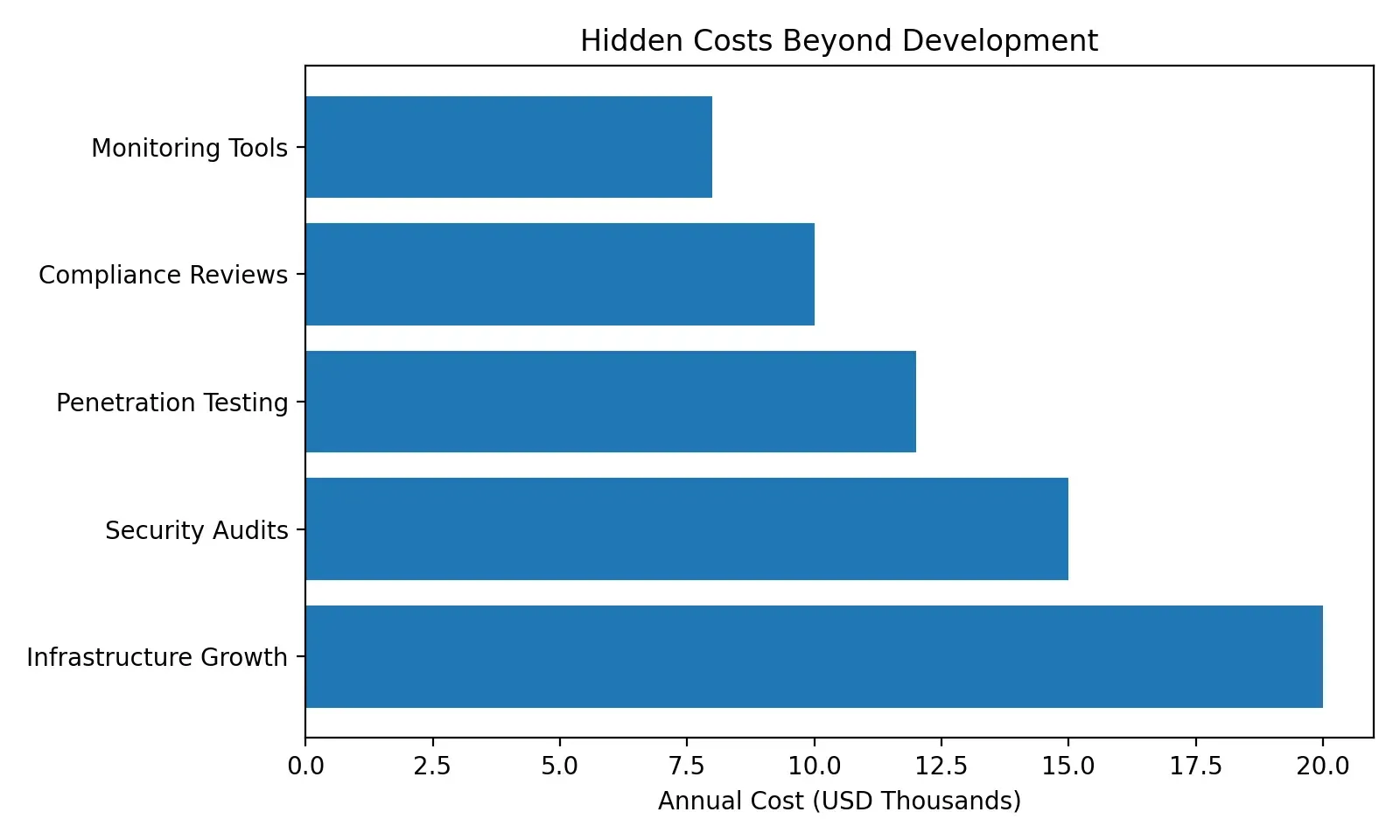
A common mistake among healthcare founders is budgeting based on basic development hours alone. In reality, one-time launch requirements like penetration testing, cloud security provisioning, and compliance audits account for a significant portion of the initial setup.
Architecture Costs: Where Most of the Budget Actually Goes
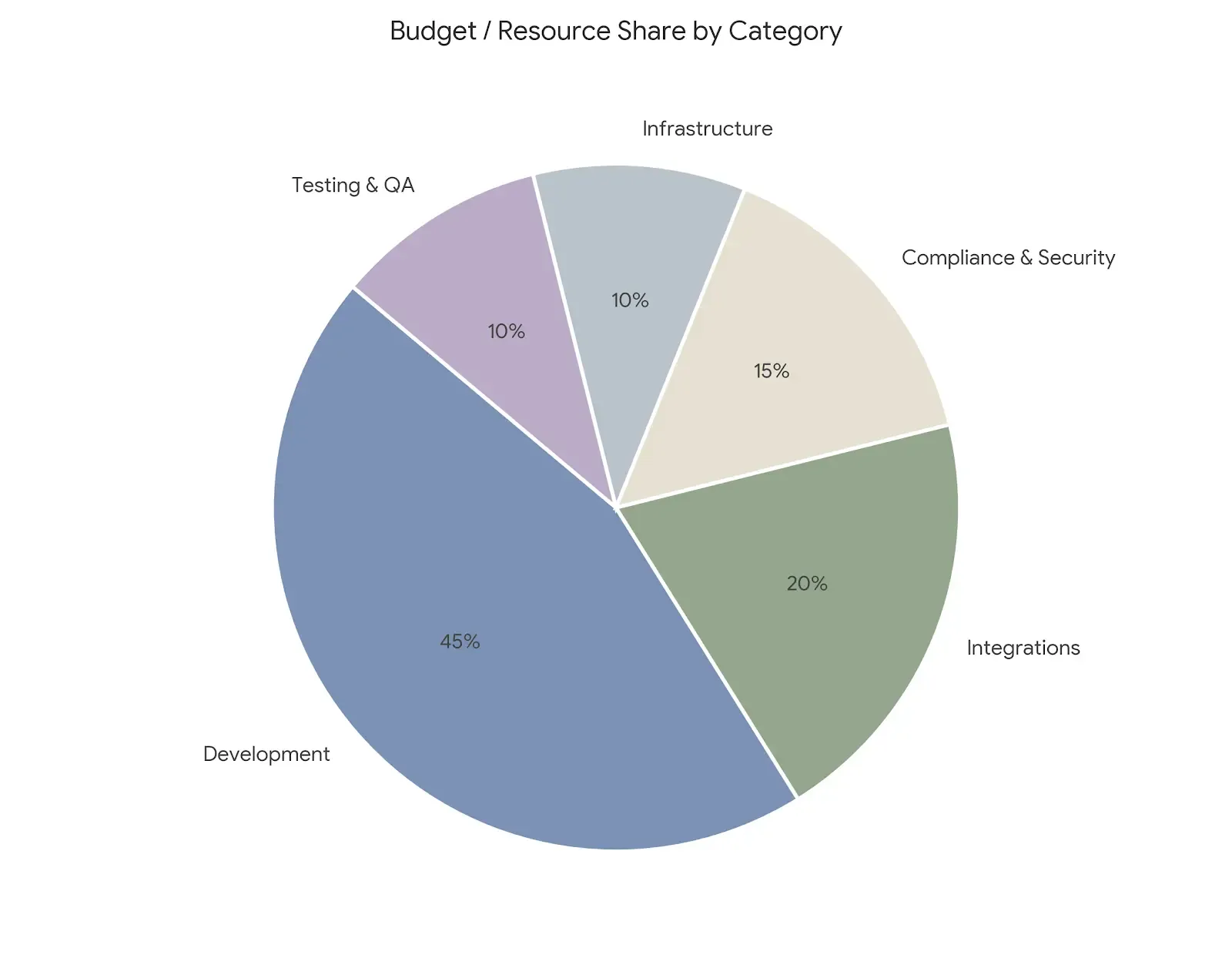
Many founders assume the language model is the most expensive part of a healthcare AI project. In reality, the model is often only one layer in a much larger system. Healthcare AI architecture planning often has a greater impact on long-term costs than model selection because it influences integrations, security controls, scalability requirements, and compliance readiness.
Where Healthcare AI Budgets Typically Go
| Component | Estimated Cost (USD) | Technical Purpose |
|---|---|---|
| Frontend Applications | $5,000 - $20,000 | Patient-facing mobile apps or clinician dashboards. |
| Backend APIs | $10,000 - $40,000 | Secure, high-throughput REST/GraphQL data routing. |
| Authentication & Access Controls | $3,000 - $15,000 | Multi-Factor Authentication (MFA) & Role-Based Access (RBAC). |
| AI Agent Layer | $10,000 - $75,000 | Orchestration tools, guardrails, and model integration. |
| Audit Logging | $5,000 - $20,000 | Immutable, append-only security logs for regulatory review. Distributed systems should handle these logs within microservices to maintain multi-service traceability. |
| Monitoring & Alerting | $3,000 - $15,000 | Real-time threat detection, token tracking, and model drift metrics. |
| Cloud Infrastructure Setup | $5,000 - $25,000 | Provisioning dedicated VPCs, encryption keys, and isolated clusters. |
| Compliance Controls | $10,000 - $50,000 | PII masking middleware and token anonymization pipelines. |
| Framework & Orchestration | $5,000 - $15,000 | Custom Python architecture or LangChain implementation for secure clinical workflow sequencing. |
Design & Prototyping Costs
Healthcare applications often require more planning than consumer products. A mistake in a retail application may create frustration. A mistake in a clinical workflow can affect patient care, documentation accuracy, or compliance requirements.
Because of this, healthcare teams often spend additional time validating:
- Patient journeys
- Clinical workflows
- User permissions
- Data visibility
- Audit requirements
- Consent workflows
| Design Complexity | Estimated Cost |
|---|---|
| Simple Patient Portal | $2,000-$6,000 |
| AI Scheduling Assistant | $3,000-$8,000 |
| Telehealth Platform | $5,000-$15,000 |
| Clinical Dashboard | $8,000-$25,000 |
| Enterprise Healthcare Platform | $20,000-$50,000+ |
Organizations building trust in medical AI interfaces typically spend more time validating user experiences because adoption depends heavily on clinician confidence. The design phase is also where teams should address how to handle patient consent in AI workflows, role-based access policies, and visibility restrictions before development begins.
Founders preparing healthcare MVPs may also find value in our guide on How to Build a HIPAA-Compliant Telemedicine MVP for the US Market, which breaks down planning considerations, compliance requirements, and development priorities.
RAG Architecture Costs
HIPAA compliance for RAG architecture requires secure retrieval systems, protected document storage, monitoring, and access controls.
Typical RAG Development Costs| RAG Component | Cost Range |
|---|---|
| Document Processing | $3,000-$10,000 |
| Embedding Pipeline | $3,000-$12,000 |
| Retrieval Layer | $5,000-$20,000 |
| Citation Engine | $2,000-$10,000 |
| Monitoring & Evaluation | $3,000-$15,000 |
Monitoring model drift in clinical AI is important because changes in hospital charting habits or updated ICD-11 codes can cause an unmonitored agent's documentation accuracy to degrade over time, leading to billing rejections.
A growing body of healthcare AI research also emphasizes policy enforcement, PHI sanitization, and immutable audit trails as key requirements for HIPAA-aligned agent architectures.
Fine-Tuning vs. RAG for Clinical Tasks
| Approach | Initial Cost | Update Cost | Compliance Complexity |
|---|---|---|---|
| Fine-Tuning | High | High | High |
| RAG | Medium | Low | Medium |
For most healthcare startups, RAG offers a faster path to production while reducing retraining expenses. However, deploying a secure, production-ready RAG architecture requires specialized engineering. Startups save significant time and capital by partnering with external custom development teams to build these pipelines, avoiding the heavy overhead of hiring and managing an internal data engineering squad from scratch.
Vector Database Costs
Vector databases have become a critical part of modern healthcare AI. They help systems retrieve information quickly from large collections of documents, medical literature, internal procedures, and patient-approved datasets.
Questions frequently asked by founders include:
- Best vector databases for healthcare data?
- Storing ePHI in vector databases securely?
- Which option is best for HIPAA workloads?
| Platform | Typical Annual Cost |
|---|---|
| Pinecone | $2,000-$25,000 |
| Weaviate | $2,000-$20,000 |
| Qdrant | $1,000-$15,000 |
| pgvector | $500-$10,000 |
The database itself is rarely the biggest cost.
The larger expense usually comes from:
- Data preparation
- Access controls
- Monitoring
- Encryption
- Governance policies
Teams building custom LLM agents for clinicians often spend substantially more time securing data pipelines than configuring the vector database itself. Because managing ePHI embeddings in a vector environment requires flawless execution, our custom engineering teams build these secure, high-performance pipelines out of the box, ensuring your data is fully optimized and compliant without ballooning your budget.
EHR Integration Costs
The cost of integrating AI with EHR systems is often one of the largest variables in a healthcare AI project budget. A chatbot that works independently may cost tens of thousands of dollars. The same chatbot connected to clinical records can cost several times more.
EHR Integration Cost Estimates| Integration Type | Cost Range |
|---|---|
| Basic Patient Data Sync | $10,000-$30,000 |
| FHIR Integration | $15,000-$60,000 |
| Multi-System Integration | $30,000-$100,000 |
| Enterprise EHR Ecosystem | $100,000+ |
Many healthcare products rely heavily on external APIs and third-party services. While integrations create value, they can also introduce unexpected expenses over time. We covered this topic in The Hidden Costs of Third-Party APIs in Mobile Apps.
Integrating LLMs with EHR systems (FHIR) often requires:
- Secure data mapping for clinical apps
- Real-time data sync for clinical apps
- API security for health software integration
- Standardizing EHR data for AI analysis
FHIR integration cost typically depends on the number of systems involved, available APIs, data quality, and security requirements. These projects usually involve healthcare specialists, integration engineers, backend developers, and compliance reviewers. That staffing requirement significantly affects cost.
Cloud Infrastructure & Deployment Costs
The deployment environment has a direct impact on project budgets. Healthcare AI infrastructure cost varies based on deployment environments, user volume, monitoring requirements, data storage needs, and compliance obligations.
Healthcare providers frequently evaluate secure cloud architecture for patient data because infrastructure decisions affect compliance, performance, and long-term operating costs. Cloud providers offer HIPAA-eligible services, audit capabilities, and support for Business Associate Agreements when implemented correctly.
Deployment Cost Comparison| Environment | Monthly Cost |
|---|---|
| Startup MVP | $200-$1,000 |
| Early Production | $1,000-$5,000 |
| Growing SaaS Platform | $5,000-$20,000 |
| Enterprise Healthcare System | $20,000-$100,000+ |
Organizations with stricter requirements sometimes explore HIPAA compliance in AWS GovCloud environments because of additional isolation and compliance controls available for sensitive workloads.
However, cloud expenses are only part of the equation. Monitoring, logging, backups, disaster recovery, and security operations often become recurring costs that founders underestimate during planning.
The Hidden Costs Most Healthcare Founders Miss
Many healthcare startups build their initial budget around development hours. Unfortunately, that only tells part of the story. The largest surprises often appear after the product starts handling real users, real patient information, and real compliance obligations.
AI compliance costs healthcare organizations incur often include security reviews, documentation, audit preparation, monitoring tools, and third-party assessments.
Common Hidden Costs| Expense | Estimated Cost |
|---|---|
| Security Audit | $5,000-$25,000 |
| Penetration Testing | $5,000-$30,000 |
| Compliance Documentation | $3,000-$15,000 |
| SOC 2 Preparation | $10,000-$50,000+ |
| Monitoring Tools | $2,000-$20,000/year |
| Incident Response Planning | $2,000-$15,000 |
| Legal Review | $3,000-$20,000 |
| Vendor Risk Assessments | $2,000-$10,000 |
Organizations that are building SOC 2-compliant healthcare software frequently discover that documentation and process work consume far more time than expected. Likewise, managing third-party risk in healthcare AI often requires vendor reviews, security questionnaires, and contractual protections that never appear in initial development estimates.
Business Associate Agreements (BAAs) and Compliance Costs
Many healthcare founders encounter the term BAA early in their planning process but underestimate its importance. A Business Associate Agreement defines how vendors handle protected health information and outlines responsibilities around security and privacy.
Compliance Documentation Budget| Activity | Estimated Cost |
|---|---|
| BAA Reviews | $2,000-$10,000 |
| Security Policies | $3,000-$15,000 |
| HIPAA Documentation | $3,000-$15,000 |
| Risk Assessments | $3,000-$20,000 |
| Compliance Reviews | $5,000-$25,000 |
While these activities do not directly add features, they help reduce regulatory and operational risk.
Team Structure and Development Costs
Essential Team Roles| Role | Typical US Hourly Rate |
|---|---|
| Product Manager | $80-$180 |
| Healthcare Business Analyst | $75-$175 |
| AI Engineer | $100-$250 |
| Backend Developer | $80-$200 |
| Frontend Developer | $70-$180 |
| DevOps Engineer | $90-$220 |
| QA Engineer | $50-$120 |
| Security Consultant | $120-$300 |
| Compliance Specialist | $100-$250 |
Outsourcing vs. In-House Healthcare AI Development
Many founders face an important question:
Should we hire internally or partner with a development company?
The answer depends on budget, timeline, and long-term goals. Healthcare organizations seeking faster time-to-market for medical AI products often choose external development teams because hiring specialists individually can take months.
Cost Comparison| Approach | Annual Cost |
|---|---|
| Small Internal Team | $500,000-$1M+ |
| Mid-Sized Internal Team | $1M-$2M+ |
| Specialized Development Partner | $75,000-$500,000+ |
| Hybrid Team | $200,000-$1M+ |
Choosing the right development approach is often just as important as choosing the technology itself. For founders evaluating different team structures, our article In-House vs Agency vs Freelancers: How US Startups Build Mobile Apps provides additional perspective.
When comparing outsourcing vs. in-house healthcare AI dev, many startups find that external teams provide access to specialists they would struggle to hire independently. This is especially valuable during MVP development.
If you’re considering working with an external team, our Startup’s Checklist for Choosing the Right Mobile App Development Partner outlines evaluation criteria that also apply to healthcare software projects.
How Specific Features Affect Development Budget
Features often determine project cost more than AI itself. Many healthcare organizations focus heavily on model selection while underestimating workflow requirements. The reality is that integrations, permissions, reporting, and operational processes frequently consume more hours than prompt creation.
Feature Cost Breakdown| Feature | Estimated Cost | Compliance & Technical Impact |
|---|---|---|
| User Authentication | $2,000-$10,000 | Must include session timeouts and secure token rotation. |
| Multi-Factor Authentication | $2,000-$8,000 | SMS, email, or authenticator app integration for identity verification. |
| Patient Portal | $5,000-$25,000 | Secure views ensuring patients only see authorized data fields. |
| Secure Messaging | $5,000-$20,000 | End-to-end encrypted chat modules with auto-delete capabilities. |
| AI Chat Interface | $5,000-$25,000 | Real-time streaming UI with localized input validation. |
| Reporting Dashboard | $5,000-$30,000 | Dynamic, aggregated data visualization for clinical oversight. |
| Consent Management | $3,000-$15,000 | Legally binding click-wrap agreements and digital signature capture. |
| Audit Logs | $5,000-$20,000 | Admin panels displaying access records for internal compliance officers. |
| Notifications | $2,000-$10,000 | Stripping PHI from push notifications while preserving context. |
Founders often underestimate how quickly additional features affect budgets. For a broader perspective on planning development investments, see our App Development Cost Calculator 2026 USA guide.
Healthcare organizations investing in patient portal security improvements often prioritize audit logging and access controls before expanding AI functionality.
Advanced Features With High Cost Impact
Advanced healthcare AI capabilities can significantly increase budgets because they require specialized expertise, testing, and infrastructure. Building reliable AI for diagnostic support typically requires additional validation, clinician review processes, testing protocols, and performance monitoring.
Advanced Feature Costs| Feature | Estimated Cost |
|---|---|
| Clinical RAG System | $20,000-$100,000 |
| Medical Note Generation | $20,000-$75,000 |
| AI Medical Coding | $30,000-$100,000 |
| Clinical Decision Support | $50,000-$250,000 |
| Remote Monitoring Analytics | $30,000-$150,000 |
| Medical Image Analysis | $75,000-$500,000+ |
What Does a HIPAA-Compliant AI Agent Actually Cost?
Build vs Buy Healthcare AI Cost Comparison (3-Year View)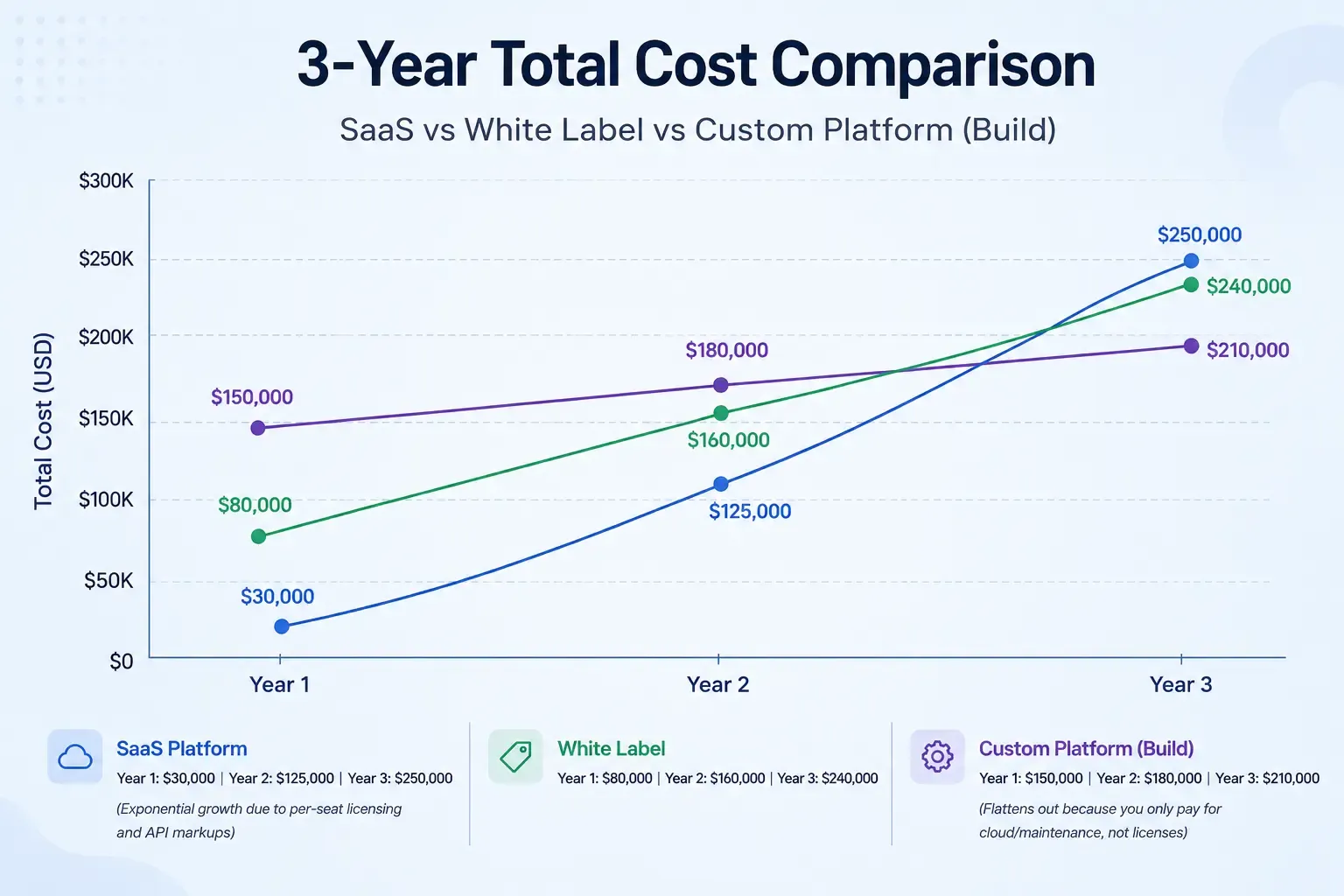
Healthcare AI implementation cost varies significantly depending on compliance requirements, integrations, deployment architecture, and workflow complexity.
While off-the-shelf SaaS products offer a deceptively low barrier to entry in year one, they quickly turn into a financial trap for growing healthcare startups. Because SaaS providers charge per-user, per-patient encounter, or add heavy markups on AI token consumption, subscription costs scale exponentially as your user base grows. Furthermore, off-the-shelf software gives you zero Intellectual Property (IP) value.
By year three, custom-built solutions consistently prove more cost-effective. When you build from scratch, the core architecture is fully owned, recurring licensing fees are eliminated, and costs scale linearly with raw cloud infrastructure rather than user count. Organizations requiring deep EHR integration, custom data pipelines, and total workflow control save hundreds of thousands of dollars in the long run by investing in custom development upfront.
After reviewing compliance requirements, architecture decisions, integrations, staffing, and feature complexity, most healthcare founders ask the same question: What should we realistically budget?
The answer depends on the problem being solved. A scheduling assistant and a clinical intelligence platform may both be called AI agents, but the technical requirements are dramatically different.
Total Budget Estimates by Project Type
| Project Type | Timeline | Estimated Cost |
|---|---|---|
| Patient Scheduling Assistant | 2-3 Months | $20,000-$50,000 |
| AI Intake Assistant | 2-4 Months | $30,000-$80,000 |
| Telehealth Support Agent | 3-5 Months | $50,000-$120,000 |
| AI Medical Scribe | 4-6 Months | $75,000-$200,000 |
| Clinical Knowledge Assistant | 4-8 Months | $100,000-$300,000 |
| Revenue Cycle Automation | 6-12 Months | $150,000-$500,000+ |
| Enterprise Healthcare AI Platform | 6-18 Months | $300,000-$1M+ |
Organizations developing healthcare CRM development platforms, medical billing automation software, or automated lab result notification apps typically fall within the mid-range categories. Meanwhile, companies building comprehensive patient engagement ecosystems often move into enterprise-level budgets.
Development & Delivery Work Breakdown
Many stakeholders want visibility into where development hours are spent. The table below represents a typical healthcare AI project that includes compliance requirements, AI functionality, integrations, and deployment.
Example Delivery Estimate| Activity | Approx. Hours | Approx. Cost |
|---|---|---|
| Discovery & Planning | 60-120 | $6,000-$20,000 |
| UI/UX Design | 80-200 | $8,000-$30,000 |
| Backend Development | 200-600 | $20,000-$100,000 |
| Frontend Development | 150-400 | $15,000-$60,000 |
| AI Development | 150-500 | $20,000-$120,000 |
| EHR Integration | 100-500 | $15,000-$100,000 |
| QA & Testing | 80-250 | $5,000-$30,000 |
| Security Review | 40-120 | $5,000-$20,000 |
| Deployment | 20-80 | $2,000-$10,000 |
How to Reduce Healthcare AI Development Costs
Reducing costs does not mean cutting corners. Instead, it means making better decisions during planning. Many healthcare startups spend money solving problems that could have been avoided with clearer requirements.
Practical Cost Reduction Strategies
Start With a Narrow Scope
Avoid building every feature during version one. Focus on solving one measurable problem first. This approach is particularly effective when building an MVP for a health startup.
Use RAG Before Fine-Tuning
Many organizations can achieve strong results using retrieval systems instead of custom model training. This often reduces both development and maintenance costs.
Plan Compliance Early
Automating HIPAA compliance in software dev becomes much easier when compliance requirements are considered during planning rather than after launch.
Involve Clinicians Early
One of the biggest causes of rework is building features that don't align with actual healthcare workflows. Clinician feedback reduces wasted development effort.
How Budventure Technologies Can Help
Healthcare AI projects require more than development skills. Successful products combine healthcare workflows, security planning, compliance awareness, cloud infrastructure, integration expertise, and product strategy.
When evaluating a healthcare AI development company in the USA, organizations should review healthcare experience, compliance knowledge, integration expertise, and long-term support capabilities.
At Budventure Technologies, our team helps healthcare startups, SaaS providers, clinics, and healthtech companies build custom healthcare software aligned with business goals and regulatory requirements.
Our services include:
- AI Development Services
- Healthcare Software Development
- Custom Software Development
- API & Integration Development
- Product Discovery & MVP Development
Whether you’re exploring AI for mental health app development, remote patient monitoring software architecture, automated triage chatbots for clinics, healthcare workflow automation tools, or AI-powered home healthcare coordination, careful planning during the early stages can significantly reduce cost and risk. You can further contact our team for the project consultation.
FAQ About Healthcare AI Development
Starting a new project or
want to collaborate with us?