

Why Adding AI Too Early Can Slow Your Startup’s Growth (And How to Know If It’s Too Soon)
Every startup founder in 2025 hears the siren song of artificial intelligence. Venture capitalists are pouring money into AI, competitors boast “AI-powered” features, and it feels like adding AI is the next must-do for success. In fact, 64% of U.S. VC funding in H1 2025 went into AI startups, fueling the perception that every new venture needs AI to survive. But here’s the hard truth: startups rarely fail because of bad tech. They fail to adopt the right tech at the wrong time. Implementing AI too early is a prime example of wrong timing. It can distract you from product-market fit, burn through resources, and even slow down your overall growth.
Reality check: Nearly 8 in 10 companies had deployed some form of AI by late 2024, yet roughly the same percentage saw no impact on their earnings. This “AI paradox”, broad adoption without clear ROI, shows that simply jumping on the AI bandwagon can be a costly distraction for a startup without a solid reason.
So before you rush to label your product as “AI-driven,” take a step back. This blog will explain why adding AI too soon can hurt your startup and provide a practical lens to determine if you’re really ready for AI or just chasing hype. We’ll explore the warning signs that it’s too early, and how to time AI adoption right to amplify your growth instead of stifling it.
The Pressure to Adopt AI and the Hidden Risks
It’s easy to understand the attraction of AI for startups. AI is the buzzword of the mid-2020s; it’s in boardroom strategies and investor pitch decks. Tools like ChatGPT became household names almost overnight, making AI seem essential. Media and investors are obsessed with AI, pushing valuations of AI companies into the stratosphere. In this climate, founders feel that if they don’t integrate AI, they’ll be left behind.
However, hype can cloud judgment. Yes, many startups are leveraging AI to scale faster, but not every AI experiment succeeds. According to McKinsey, almost 80% of companies using generative AI report no significant bottom-line impact. In other words, AI isn’t a guaranteed ticket to success. It can just as easily become an expensive distraction. If AI doesn’t clearly accelerate your growth or add a unique advantage, you won’t impress anyone by adding a “.ai” to your name.
Consider the bandwagon effect: founders see competitors adding chatbots or predictive algorithms and fear missing out. Sometimes, even investors nudge, “Have you thought about adding AI?” It creates pressure to do something with AI, even if your startup isn’t ready. But jumping in too soon can backfire. As one industry expert bluntly put it, “adding AI too early is rarely a tech problem – it’s a judgment problem.” The technology might be exciting, but the timing might be all wrong.
The Cost of Being Too Early
Startup history is littered with examples of premature scaling, doing too much, too soon. In fact, studies show that over 70% of failed high-growth startups collapsed due to premature scaling (growing technology or operations before the fundamentals were in place). Adding AI prematurely is a textbook case of premature scaling in tech:
- Complexity Before Clarity: AI demands data pipelines, model training, and specialized talent. Introduce it too early, and you’ve layered intense complexity onto a product that might not even have its basics figured out. Founders end up over-engineering before any users even exist, when they should be keeping things simple. It’s like trying to install a rocket engine on a bicycle – overkill and likely counterproductive.
- Delayed Launches and Missed Deadlines: An MVP (Minimum Viable Product) bogged down with AI features can take vastly longer to build. One seasoned engineer noted that teams actually ship faster when they delay AI – they spend time clarifying the product and goals first, instead of wrestling with machine learning around unclear objectives.
- Distraction from Product-Market Fit: In early stages, your #1 goal is to achieve product-market fit – to ensure you’re solving a real user problem in a way users love. Founders must remember: a startup succeeds because it delivers unique value, not because it uses trendy tech. As we advised in our guide “When Your Startup Should Not Build a Mobile App (Yet),” you shouldn’t invest in major development (whether a native app or an AI system) until you’ve validated the fundamental user need and solution.
- Resource Drain (Money & Talent): Building even a simple AI feature can be expensive. Data infrastructure, cloud compute for training models, and AI/ML engineers’ salaries – these are high costs. Early-stage startups usually operate on tight budgets and small teams. Can you really afford to divert tens of thousands of dollars and several developer-months to an AI experiment right now? Often, the answer is no. Embracing AI is a commitment: without an adequate budget or expertise, you risk costly missteps.
- Lack of Data = Garbage In, Garbage Out: AI runs on data. Early on, you might not have enough user data or domain data to train a meaningful model. If you attempt AI without sufficient data, your algorithm is essentially “flying blind.” It’s a wasted effort, or worse, it could lead you to wrong conclusions. Many startups in their first year simply don’t have the quantity or quality of data for reliable AI. You can try using public datasets or synthetic data, but that adds complexity and often doesn’t reflect your business’s unique reality.
- Poor User Experience & Trust Risks: When implemented hastily, AI can break things in ways you didn’t anticipate. For example, an “AI-powered” chatbot that isn’t properly tuned might give nonsense answers or even harmful advice to your customers. In one Reddit story, a founder discovered their rushed AI support bot recommended a competitor’s product to a user – an absolute nightmare scenario. A half-baked AI can confuse or disengage users, hurting your brand’s trust. As one support expert put it, in the first stage (say, your first 500 customers), you need conversations, not automation. Only once you have volume and clear standard operating procedures does it make sense to carefully layer in AI for efficiency.
- No Clear ROI or Use-Case: Perhaps the biggest red flag is when a startup wants to add AI “because everyone’s doing it” or to sound impressive, but without a specific problem in mind. If you cannot clearly answer, “What will AI improve or enable that we can’t do otherwise?”, then you’re probably not ready. Adding AI with no clear use-case is like building a solution searching for a problem. Over-automation without strategy is a known pitfall – you might end up automating the wrong thing or optimizing something that doesn’t matter for your customers.
- Investor and “Buzzword” Pressure: Ask yourself honestly: Why are we considering AI right now? If the answer is “Our investors (or advisors) think it’s a good idea” or “Our competitors all claim to have AI, so we feel we should too,” that’s not a good enough reason. Investors ultimately care about traction – user growth, revenue, engagement – not whether you have a neural network running in the backend. Don’t fall victim to buzzword FOMO.
In summary, adding AI too early can slow your startup down in multiple ways: development slows under extra complexity, your team loses focus on core objectives, you burn cash and time, and you may even deliver a worse user experience. It’s a classic case of diminishing returns: lots of input for little output.
How to Tell If It’s Too Early for AI (Signs You Should Wait)
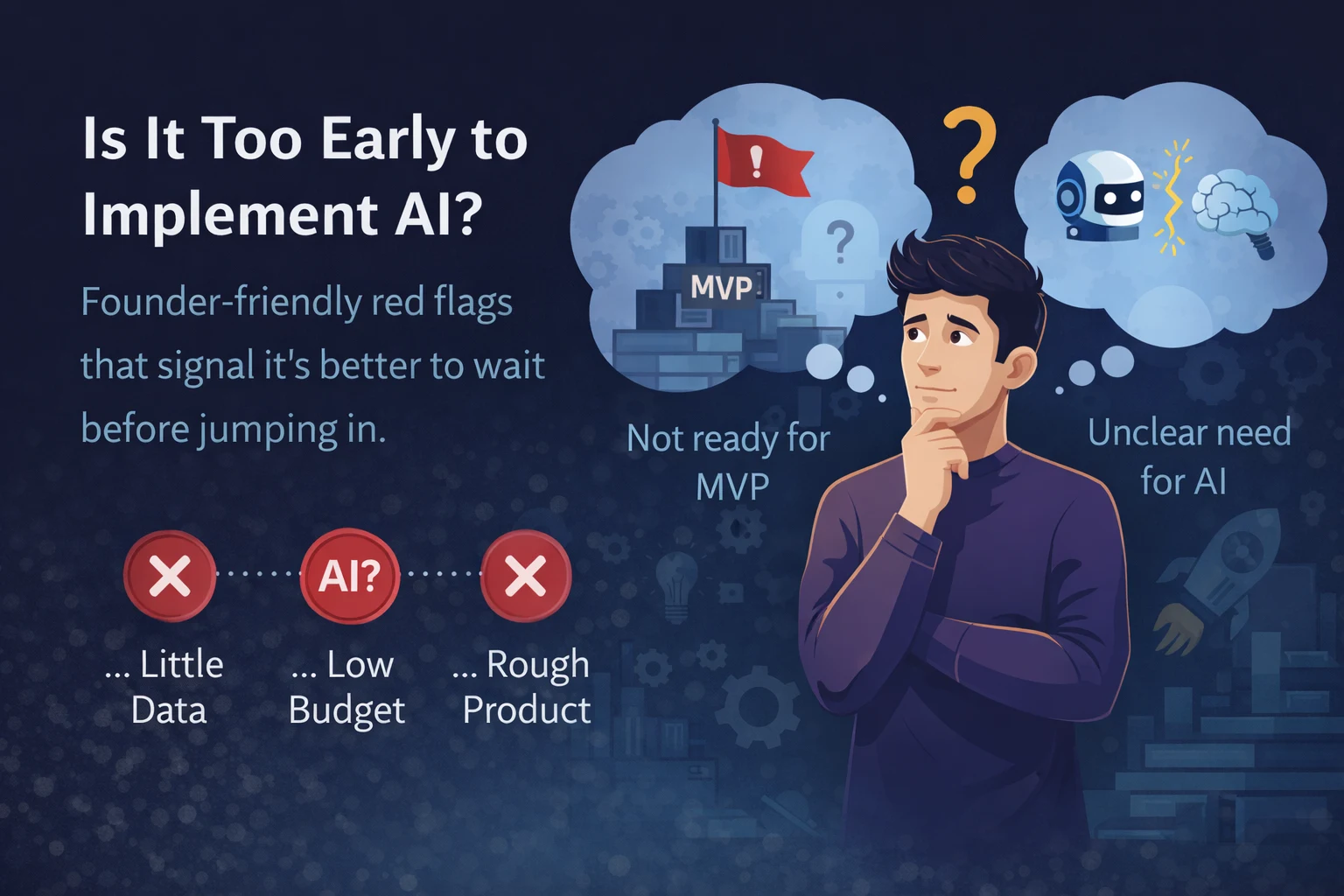
How do you know if your startup is truly ready for AI or if you’re about to jump in too soon? Here are some founder-friendly signs that it’s probably too early to implement AI in your product:
- You’re Pre-MVP or Pre-Product-Market Fit. If you haven’t launched a viable product yet, or you’re still trying to find any users who love what you’re offering, that’s step one. At the idea-stage or MVP-stage, AI is usually overkill. Your focus should be on validating the core idea with the simplest possible solution. If you can’t confidently say you have product-market fit yet, pause on the AI. (Relatedly, if you’re debating fundamental questions like whether to build a mobile app or web app first, that’s a sign you’re still nailing the basics – adding AI on top of an unproven foundation won’t help.)
- No Clear Use-Case for AI (Solution Searching for a Problem). Be brutally honest: Is there a specific problem or feature in your business that plainly demands AI to solve? If you’re just brainstorming “how can we use AI somewhere in our product?” then it’s likely too early. Don’t use AI as a hammer looking for a nail. For instance, if your app is a simple two-sided marketplace connecting users, do you really need a machine learning model right now, or do you just need a decent matching algorithm? You should be able to articulate, “We need AI because it will do X, which we cannot achieve with simpler methods.” If you can’t fill in that X clearly, then hold off.
- You Don’t Have Enough Data (Yet). Do you have datasets large and rich enough to train or feed an AI system meaningfully? Early on, you probably have limited user interactions, perhaps a few hundred signups, or minimal usage data. AI thrives on data – whether it’s user behavior, images, text logs, etc. If data is sparse, focus on growing usage and manually gathering insights for now. You can always apply AI once you have thousands of data points rather than dozens.
- A Simpler Solution Can Do the Job. This is crucial. Ask: Can we solve this problem with basic logic or off-the-shelf tools? If yes, do that first! Not every problem needs a complex AI solution. In fact, many startups waste money on AI when a straightforward script or conventional software would work. For example, if users need to be notified of something on your platform, a scheduled script or push notification is fine – you don’t need AI.
- Your Core Product Isn’t Solid Yet. If you’re still discovering bugs in your core features, or your UI/UX isn’t refined, or users are confused about the value, fix that first. Enhancing a shaky product with AI is like putting fancy turbo boosters on a car with wobbly wheels. It doesn’t fix the fundamentals. Ensure your app or service works well, delivers clear value, and has a decent user experience without AI. Only then ask, “Could AI meaningfully improve this?” Focus on product-market fit, usability, and reliability before AI.
- Limited Budget & No AI Expertise. If you don’t have the team or money to do AI right, don’t do it yet. Implementing AI is not just a one-time build; models might require tuning, retraining, and maintenance. If your current team is two web developers with no machine learning experience, who’s going to build and maintain the AI? If you’re thinking “We’ll just learn as we go” or “We’ll outsource it cheaply,” be very cautious. And outsourcing isn’t a silver bullet either – you still need to manage the project and integrate it. If you can’t easily hire or contract experienced AI developers (and manage them), that’s a sign to wait. When you do reach that stage, you’ll face the classic question of in-house vs. agency vs. freelancers for development.
- Uncertain Metrics for Success If you decided to add AI, do you know what success looks like? For example, are you trying to increase conversion by 10% via better recommendations, or cut support response time in half with a chatbot? If you haven’t thought about how to measure the impact of AI, that’s a warning sign. Adopting technology without defining success metrics is risky. You might spend months on something that doesn’t actually move the needle for your business.
If several of the above points sound like your situation, your startup should probably not pursue AI yet. And that’s okay! There is absolutely no shame in waiting. In fact, restraint can be a competitive advantage. By getting your fundamentals right first, you set your startup up for greater success when you do integrate AI or any advanced tech. Remember, many of today’s successful companies didn’t start with AI. Stripe, Airbnb, Dropbox – none of these were “AI startups” at the beginning, yet they went on to dominate their markets without an AI-first approach. They focused on solving a real problem exceptionally well.
The takeaway: don’t let hype dictate your roadmap.
When Is the Right Time to Add AI?
We’ve hammered on caution a lot, but we’re not anti-AI – we’re pro timing. AI can be transformative when introduced at the correct stage for the right reasons. So, how do you know when that time has come? Here are a few positive signals that adding AI could be worthwhile.
- You have a specific, validated use-case for AI. Perhaps through using your product, you’ve identified a particular challenge that simple methods can’t solve. Maybe users are asking for smarter personalization (“Can your app recommend content I’d like?”), or you’re drowning in data that needs machine learning to extract insights. If you can clearly state “We will use AI to do X, which will result in Y improvement for our business/users,” then you’re on the right track. Having a concrete problem and goal is step one for justified AI.
- Your user base and data have reached critical mass. Perhaps you’ve grown to tens of thousands of users and collected a significant dataset. At this scale, patterns emerge that no human can manually sift through efficiently. For instance, you notice in your analytics that different segments of users behave very differently, and a one-size-fits-all approach is no longer optimal. If you have heaps of data or lots of user activity where discovering patterns or personalizing experiences is key, AI might add real value.
- The problem involves complexity or uncertainty beyond simple rules. AI shines when the solution isn’t straightforward “if-then” logic. If your startup’s value proposition has evolved to deal with messy data (images, natural language, complex predictions), that’s a good sign AI is the appropriate tool. For example, if your app needs to analyze photos users upload for quality or content, that’s hard to do with just rules, but AI (computer vision) can handle it. Or if you need to detect fraudulent behavior that doesn’t have clear-cut rules, a machine learning model might catch patterns that humans or basic scripts miss. When context and learning from data matter, AI might be warranted.
- You’ve nailed the basics and are looking to scale or differentiate. This is key: the best time to layer in AI is after you have a working product and understand your users’ needs deeply. Maybe you’ve noticed, for example, that users love your solution but are saying things like, “I wish it could automate this part for me” or “It’d be great if it got smarter over time.” That’s a green light. If AI feels like a natural extension that can enhance or scale an already successful product, rather than a Hail Mary to find traction, you’re in a good position. That’s when AI can come in to augment your team or product and relieve the strain.
- Your competitors or industry demand it (and you’re ready to execute). In some sectors, AI truly is becoming table stakes, but usually this applies once you’re past the MVP stage. If you’re in a domain like fintech fraud detection, medical diagnostics, or cybersecurity, advanced AI/ML capabilities might be necessary to compete at higher levels. The caution: make sure you’re doing it because it delivers value, not just because the competition’s marketing says “now with AI!” If customers in your market are expecting AI-level performance (e.g., a cybersecurity client expects AI-driven threat detection because all vendors offer it), that might dictate your roadmap. Just ensure you have the resources and know-how to do it effectively – being “forced” to add AI before you’re ready can still be dangerous if you lack the capability.
If these positive conditions are in place, you can move forward more confidently with AI. To execute wisely, consider these final tips:
- Start Small and Lean: You don’t have to build a giant AI infrastructure from day one. Explore quick wins: for instance, use existing AI APIs or pre-trained models to test the waters. Cloud services (like OpenAI’s GPT for text, or Google’s Vision API for images) let you experiment without a huge upfront investment. If a third-party tool can handle your use-case, try that with a subset of users. This way, you validate the impact of AI on your product before committing to heavy R&D. If the results look promising – e.g., users respond well to the new AI-powered feature – you can then invest in a more custom, robust solution.
- Measure and Iterate: Define what success looks like for your AI feature and closely monitor it. If you add an AI support chatbot, track resolution rates and customer satisfaction compared to human support. By measuring outcomes, you can adjust or even roll back if it’s not delivering. AI isn’t a set-and-forget deal – models might need retraining, and user behavior might change. Have a plan for ongoing maintenance: who will improve the model as new data comes in? How will you monitor for errors or bias? Knowing this ahead of time ensures your AI addition stays effective and doesn’t degrade over time.
- Ensure Human Oversight (especially at first): When you first deploy an AI feature, keep a human in the loop if possible. This could mean reviewing AI outputs periodically, or having a fallback to manual processes if the AI gets something wrong. For instance, if you launch an AI content moderator, maybe flag uncertain cases for a human to review initially. This protects your users and brand while your AI “learns the ropes” in the real world. As one expert put it: the AI’s real skill often should be knowing when to hand off to a human in the early stages.
- Consider Partnering for AI Expertise: If you’ve decided AI is needed but still lack in-house expertise, choose your implementation path carefully. You might hire a machine learning engineer or a data science team, but many startups instead opt to partner with an experienced AI development firm to accelerate the process. Whether you develop in-house or with a partner, ensure they understand your business context deeply. (For a non-AI parallel, think of how you’d decide a mobile app development partner, you’d want someone who gets your startup’s needs and can execute a plan, not just write code).
- Maintain Focus on the User Problem: Finally, even when you add AI, don’t let it overshadow your core value. AI is a means to an end. Keep asking: Is this making the experience better for our users? Is it solving the problem better than before? If at any point the AI feature complicates things or detracts from the user experience, be ready to tweak or even remove it. In fact, in some cases, teams have bravely removed an AI after adding it, realizing a simpler approach was actually working better. That’s not a failure; it’s smart product management.
We’ve seen multiple US-based startups slow down after adding AI too early, not because the models failed, but because decision-making became heavier, iteration slowed, and teams spent months tuning systems users weren’t asking for yet. In contrast, startups that delayed AI until workflows stabilized consistently shipped faster and adapted more easily when they eventually introduced intelligence.
Conclusion: Focus on Timing and Fundamentals
In the current wave of AI enthusiasm, it’s important to remember that technology is a tool, not a magic wand. For startups, when you use that tool is as significant as how you use it. Adding artificial intelligence can indeed be game-changing, but only if your startup is ready and the use-case truly demands it.
The path to startup success still runs through age-old fundamentals: understand your users, solve a real problem, build a lean product, and iterate based on feedback. If AI can help you do that faster or better at the right stage, then by all means, leverage it, and it will turbocharge an already working engine. But if you bolt it on too soon, it’s likely to slow you down or throw you off course.
So, does your startup need AI right now? Only you can answer that by reflecting on the stage and needs of your business. If you’re early and those red flags are waving. Don’t be afraid to say “not yet” to AI. Your focus and speed will likely improve as a result. When the green flags start to appear, you’ll approach AI implementation with a clear purpose, adequate data, and a strong foundation, making it far more likely to succeed.
Remember, technology timing is a strategic decision. Make that decision with eyes wide open, not because of hype. Meanwhile, keep your product simple, your learning rapid, and your customers happy. The rest will follow.
Need help figuring out the right tech strategy for your startup? Whether it’s when to build that mobile app or how to integrate AI effectively, we’ve got resources and experts who can guide you. The key is making informed, stage-appropriate choices; that’s how young companies turn into enduring successes.
Frequently Asked Questions About AI for Startups
Does every startup need AI?
No. Most early-stage startups do not need AI. If a simpler solution works and product-market fit is not proven, AI often adds complexity without improving outcomes.
Can adding AI too early slow a startup down?
Yes. Adding AI before validation can delay launches, increase costs, distract teams, and reduce focus on core user problems.
When is the right time for a startup to add AI?
AI makes sense once a startup has stable usage, meaningful data, a clear use-case, and defined success metrics tied to business outcomes.
What should startups build before AI?
Startups should first validate their core product, user workflows, acquisition channels, and retention before considering AI features.
What should startups build before AI?
No. Investors care more about traction, revenue, and growth. AI without clear value rarely improves fundraising outcomes.