


Does Your Startup Actually Need AI? A Practical Decision Framework for 2026
Artificial intelligence is everywhere in 2026 – from boardroom strategies to investor pitch decks. Startup founders often feel pressure to label their products as “AI-powered” to stay current with trends. In fact, 64% of U.S. venture capital funding in the first half of 2025 went into AI startups. With headline-grabbing successes of AI firms and tools like ChatGPT becoming household names, it’s easy to assume every new business must integrate AI to survive. But pause for a moment: does your startup actually need AI, or are you chasing hype at the expense of focus?
Many companies have jumped on the AI bandwagon – nearly 8 in 10 organizations deployed some form of AI or generative AI by late 2024, yet roughly the same percentage saw no material impact on their earnings. We might call this the AI paradox: broad adoption without clear ROI. For startups with limited resources, betting on AI without a solid reason can be risky.
In this guide, we’ll take a founder-friendly, practical look at startup AI decision-making. We’ll walk through a simple framework (with an AI readiness checklist) to determine when to use AI in startups – and when not to. You’ll learn how to differentiate AI vs automation, evaluate the feasibility of AI for your business, understand AI implementation risks, and decide if hiring a team or an AI development company is the right move. Let’s cut through the noise and make an informed decision about artificial intelligence in your startup’s journey.
The 2026 AI Gold Rush: Hype vs. Reality for Startups
It’s no secret that AI is the tech trend of the mid-2020s. Investors, media, and enterprise leaders are enamored with artificial intelligence. AI has evolved from a niche technology to a foundational innovation driving new dominant companies. Accordingly to sources, in 2025, private AI frontrunners like OpenAI and Anthropic achieved eye-popping valuations ($500B and $183B, respectively) as they pushed the envelope on large language models.
However, founders should separate hype from reality. Yes, many startups are leveraging AI to scale faster and unlock new value. But not every AI experiment succeeds. According to McKinsey, almost 80% of companies using generative AI reported no significant bottom-line impact from it.In other words, adopting AI is not a guarantee of success – it can just as easily become a costly distraction. The enthusiasm around AI has led to what one VC firm called a need to “differentiate hype from sustainable growth.” As a startup, you can’t afford to invest in technology without a clear benefit.
Reality Check: Investors may be prioritizing AI (over 60% of U.S. VC dollars flowed to AI startups in early 2025), but they also value traction and sustainable growth. If AI doesn’t clearly accelerate your growth or give you an advantage, you won’t impress anyone by adding a “.ai” to your name.
For examples of startups that moved too fast with AI, see Why Adding AI Too Early Slows Startups.
AI vs. Automation: Not Every Startup Problem Requires AI
Before diving further, it’s important to understand AI vs automation. The terms often get conflated, but there’s a big difference.
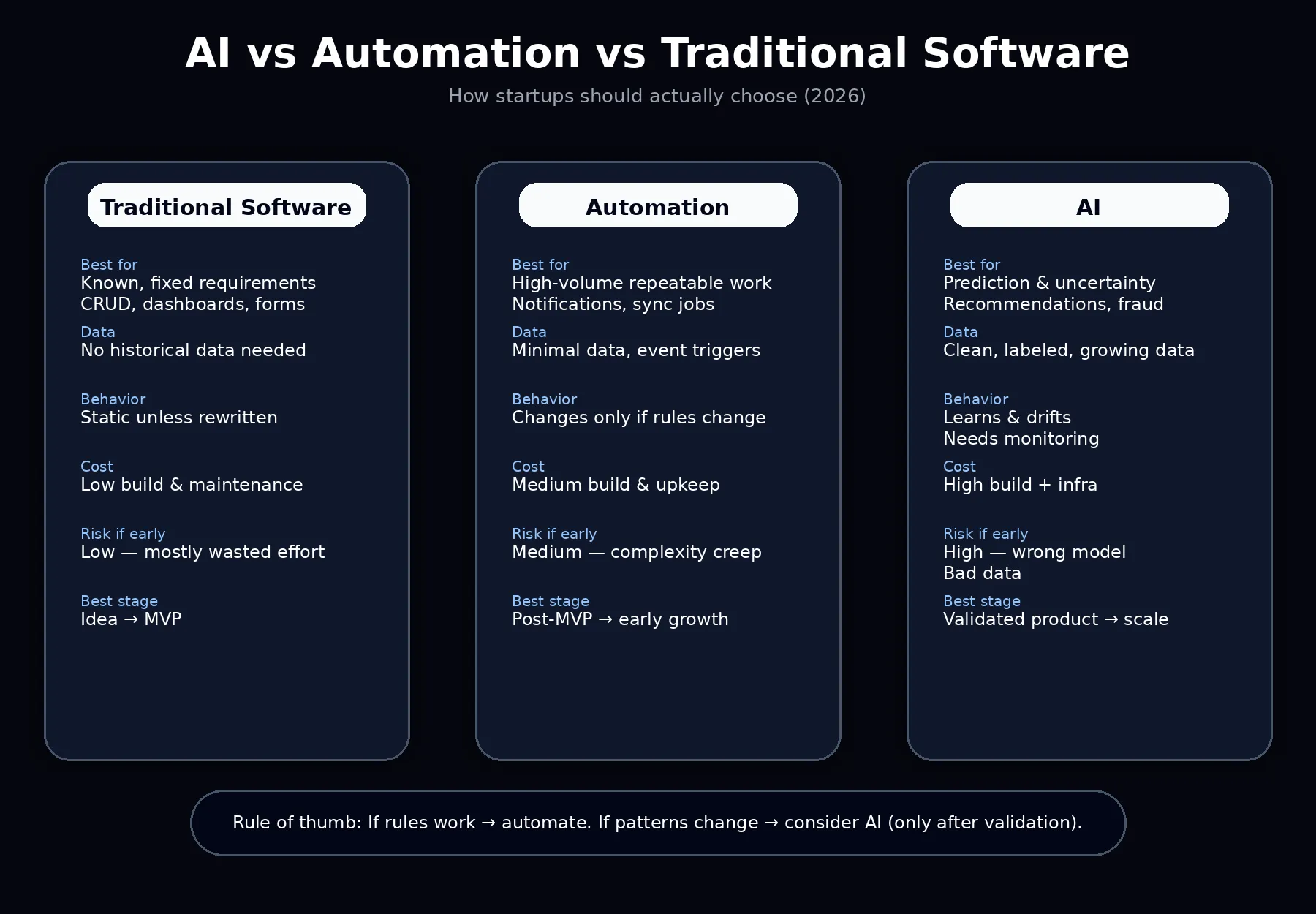
For startup founders, the takeaway is: not every problem requires AI. In fact, many organizations waste money deploying AI solutions when straightforward automation would deliver faster ROI with far less complexity. Automation can often handle your needs if the task is well-defined and repetitive. AI’s real value comes when you face unpredictable scenarios or complex data-driven problems that automation can’t solve.
Consider a simple example: If you want to notify users when they leave an item in a shopping cart, you can automate an email trigger – no “intelligence” needed. But if you would like to predict what products a user is most likely to buy next (a complex, pattern-based problem), that’s where an AI model might help.
Using AI where it isn’t necessary can backfire. If you try to use AI where a cheaper script or app would suffice, you’re adding cost and complexity without a clear benefit. AI systems are more expensive to build and maintain; they require data pipelines, training, tuning, and specialized talent. Automation, on the other hand, is typically easier to implement with standard development skills. As a lean startup, you want to solve problems in the simplest way that gets the job done. Often, traditional software or manual processes can validate your concept before you invest in AI.
In short, treat AI as a specialized tool for specific scenarios, not a default component of every solution. A good rule of thumb: If a problem can be solved with a few clear rules or simpler software logic, do that first. In the next sections, we’ll discuss how to identify those scenarios in a startup context.
When Does It Make Sense to Use AI in a Startup?
So, under what circumstances is AI development for startups worthwhile? Here are some founder-friendly guidelines on when to use AI in startups – essentially, the green flags that AI might add real value:
- You have a large scale of data or users where personalizing or discovering patterns is key. If your startup is sitting on heaps of data (user behaviors, transactions, sensor data, etc.) and you suspect some insights or patterns could drive better decisions, AI might help uncover them. For example, an AI could analyze user usage patterns to personalize recommendations or sift through data logs to detect anomalies. Prediction or pattern recognition tasks at scale are prime candidates for AI, especially when they could improve the user experience or decision-making.
- The task involves complexity or uncertainty beyond fixed rules. AI shines in scenarios where outcomes can’t be predetermined by simple if-then logic. Think of fraud detection, which involves finding weird patterns among millions of transactions, or natural language processing (like a chatbot understanding varied customer queries). If your startup’s value proposition hinges on interpreting messy, unstructured data (images, free-form text, audio) or making complex predictions (like forecasting market trends or maintenance needs), AI may be appropriate. In other words, use AI when context and learning matter – e.g., your service must adapt to user behavior over time, or make smart recommendations beyond a static flow.
- It significantly saves time or improves outcomes versus manual or traditional methods. One practical lens: would using AI meaningfully boost efficiency or effectiveness in a way that simpler tech cannot? For instance, an AI model that automates a task that humans spend hours on (and does it nearly as well or better) could be a game-changer. Many startups successfully deploy AI for things like automated customer support (via intelligent chatbots), predictive analytics to drive marketing, or image recognition to automate moderation, when these yield faster or more accurate results than manual effort. If the business case (time saved, accuracy gained, user value added) is clear and compelling, AI might be worth it.
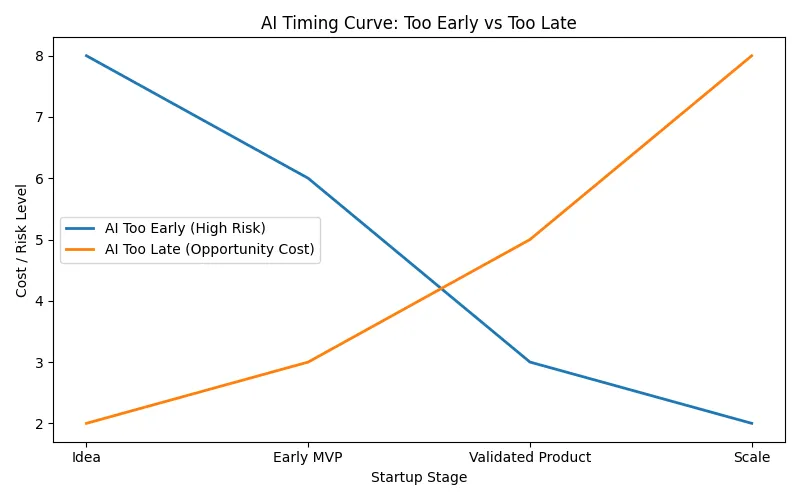
- You’ve validated your core product and see AI as a way to scale or enhance it. Timing matters. Often, the best time to add AI is after you have a working product and solid understanding of user needs. Perhaps you notice a pattern: users love your solution but are asking for smarter automation in one area – that’s a sign AI could amplify your product. A mature startup that has traction might use AI to optimize specific parts of the business (e.g., recommending the right content to the right user segment, or automating quality checks on data input). If AI feels like a natural extension that unlocks the next level of your product rather than a Hail Mary to find product-market fit, that’s a good indication.
- Your competitive advantage depends on AI capabilities. In some cases, the market demands AI. For example, if you’re building a cybersecurity platform, advanced threat detection via AI could be essential to keep up with competitors leveraging machine learning. Or if you’re in a domain like healthcare diagnostics, AI-driven analysis might be the product differentiator. Startups in certain sectors (fintech, healthtech, SaaS analytics) might reach a stage where not using AI means falling behind industry standards. Just ensure this is driven by genuine competitive and customer needs – not solely by competitor marketing.
If one or more of the above rings true for you, exploring AI app development services or building an in-house AI prototype could be justified. Crucially, make sure you define a specific use case for AI. It’s not enough to say “we want to sprinkle AI into our app.” Instead, articulate: “We will use machine learning to predict equipment failure from sensor data, reducing downtime by X%,” or “We’ll use NLP to automate 50% of our support responses, improving response time and cutting support costs.” A clear problem/solution statement will guide your efforts and help measure if the AI is working.
Finally, remember you don’t have to reinvent the wheel. In 2026, you can often start with existing AI APIs or platforms. Cloud providers and open-source models allow you to test AI ideas with minimal custom work. For instance, pre-trained AI services (like OpenAI’s GPT for text, Google’s Vision API for images, etc.) let you dip your toes in AI without a full R&D team. This can be a smart way for startups to validate an AI-enhanced feature quickly. If it works and users love it, you can then invest in deeper custom AI development tailored to your needs.
When You Should Not Use AI (Yet)
We’ve looked at when AI can add value – but it’s just as important to recognize scenarios where AI might not be the right choice. In our experience working with founders, here are common signs that your startup might not need AI at the current stage:
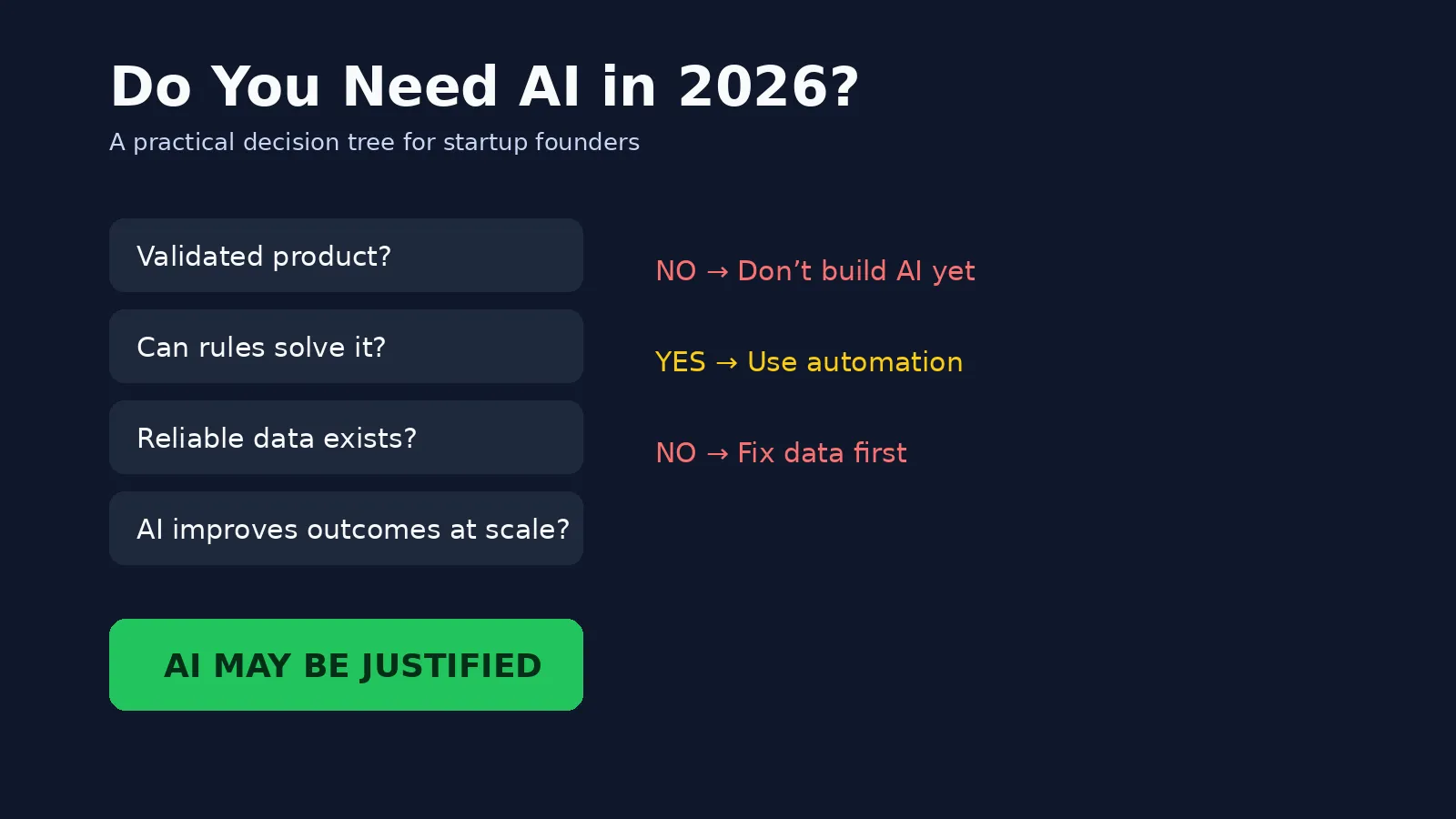
- No clear problem or use-case for AI: If you cannot clearly answer “What will AI improve or enable that we can’t do otherwise?”, that’s a red flag. Don’t use AI as a hammer searching for a nail. For example, applying AI just to have a fancy feature, without clarity on how it benefits users or the business, is likely wasted effort.
- You’re still validating product-market fit: If you’re pre-MVP or your product is very early, adding AI can distract from your primary goal of proving out the idea. Building an AI system too soon often leads to over-engineering and delayed launches, when you should be iterating quickly on basic functionality and user feedback. Many successful startups launched with simple manual or rule-based implementations (even “Wizard of Oz” setups where humans quietly did tasks behind the scenes) before automating with AI. If you haven’t nailed the basics, adding AI is like putting a rocket engine on a bicycle – overkill and possibly counterproductive.
- Insufficient data: Data is the fuel for AI. If you don’t have much user data or domain data collected yet, an AI algorithm will be flying blind. Early-stage startups often lack the quantity and quality of data needed to train reliable models. You can attempt to use third-party datasets or synthetic data, but that adds complexity and may not reflect your real users. If data is sparse, focus on growing usage and maybe manually gathering insights first.
- Limited budget or AI expertise: Embracing AI is a commitment. It can demand specialized talent (machine learning engineers, data scientists), additional cloud infrastructure (for model training or hosting), and ongoing maintenance as models need tuning. If your team doesn’t have AI/ML experience and you can’t easily hire or contract AI developers in the USA or elsewhere, be cautious. Outsourcing to an AI software development company is an option, but even then, you need to manage the project and costs. Implementing AI without the right expertise can result in costly missteps. Sometimes it’s wiser to hold off until you have the resources – or until a lightweight AI service can meet your needs without heavy investment.
- A simpler solution exists: This echoes the earlier AI vs automation discussion, but is worth reiterating. For example, if you can meet user needs with a well-designed app flow or a basic algorithm, build that. Save the fancy machine learning for when you truly hit a wall with conventional methods.
- Uncertain ROI or strategy: Adopting AI without a clear strategy can backfire. Perhaps you have an idea that AI might be useful, but you haven’t quantified the benefits or aligned it with your business goals. This “experiment and hope” approach is risky for a small company. It’s better to wait until you can define success metrics for the AI (e.g., improve conversion by X%, cut support time by Y hours/month) and have a plan to integrate it into your workflow. Over-automation without strategy is a known pitfall – you could end up automating the wrong thing or creating a solution looking for a problem.
If one or more of these points resonate, your startup should probably not pursue AI yet. And that’s okay! As we often advise entrepreneurs, get your fundamentals right first. In fact, our guide “ When Your Startup Should Not Build a Mobile App (Yet)” emphasizes waiting on major development if you haven’t validated certain assumptions. The same logic applies to AI – you wouldn’t build a complex native app without need; likewise, don’t build an AI feature until the timing and conditions are right.
Remember, plenty of successful startups reached product-market fit and even scale before layering in AI. Stripe, Airbnb, Dropbox – none of these were “AI startups” at the beginning. Even startups whose products are AI-centric often start by faking the AI behind the scenes, a technique known as “Wizard of Oz” prototyping, to test the concept. This approach helps ensure there’s real demand for the AI solution. There’s no shame in waiting on AI; it’s often the smarter choice.
The AI Readiness Checklist for Startups (2026)
How do you concretely decide if you’re ready to implement AI? Here’s a simple AI readiness checklist you can use as a decision framework. If you can confidently check most of these boxes, your startup is likely ready to pursue an AI initiative. If not, you may want to address the gaps first or hold off on AI.
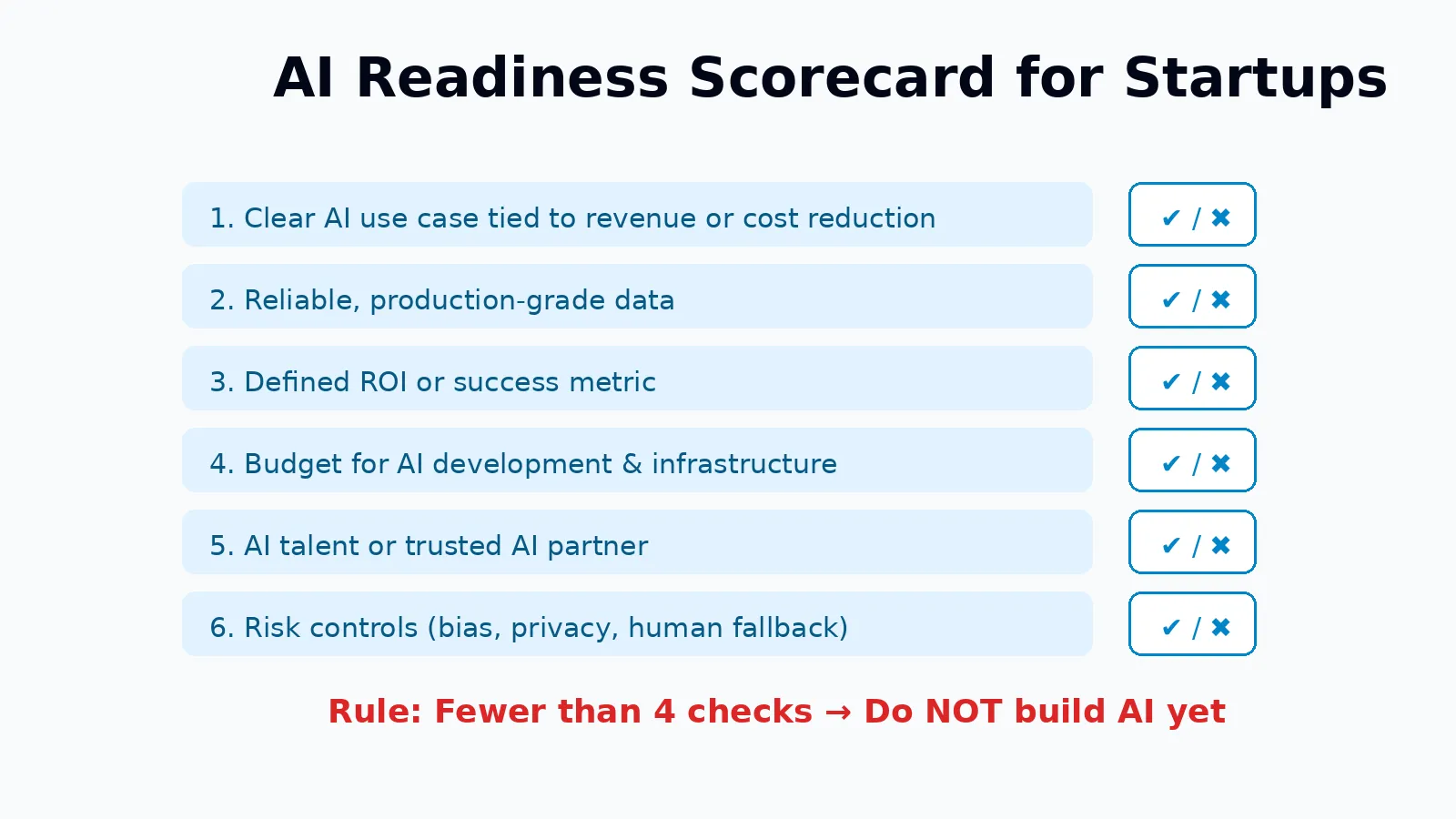
- You have identified a specific use case where AI would solve a real problem or unlock clear value for your startup. The potential benefits (e.g., automating a time-consuming task, improving accuracy, generating insights, enhancing user experience) are tangible and aligned with your business goals. You’re not just adding AI for buzz – you can articulate why it’s needed.
- You have or can obtain data of adequate quantity and quality to power the AI. This might be historical user data, images, text corpora, sensor readings, etc., relevant to the problem. The data is accessible, well-governed, and representative of the scenarios your AI will face. (No, a 50-row Excel sheet is not enough for a machine learning model!) If data is lacking, you have a plan to gather or generate it before relying on AI.
- You have assessed the costs and expertise required for AI development. Either your team has AI/ML engineering skills, or you have the budget to hire AI developers or partner with an AI development company (USA or global) for custom AI development. This includes not just building the model, but deploying, maintaining, and improving it over time. You’re prepared to invest in the needed cloud services or infrastructure (which can be significant for large models). In short, you have the people and financial resources to support the AI project from development through production.
- The AI initiative aligns with your startup’s strategic focus and stage. It addresses a core challenge or opportunity for your business. Leadership and key stakeholders (co-founders, investors, advisors) are on board and understand that this is a priority, not just an experiment. You’ve ensured that pursuing AI now won’t distract from other mission-critical work, or you’ve explicitly decided this is the area to innovate in.
- You have defined how you will measure the impact of the AI once implemented. This could be KPIs like conversion rate lift, churn reduction, cost savings, time saved, user satisfaction scores, error rate reduction, etc. There’s a baseline to improve upon, and you have targets or at least a hypothesis (“We expect the AI to improve X by Y%”). This will help judge if the AI effort is delivering ROI or if adjustments are needed.
- You’ve considered the AI implementation risks and have plans to mitigate them. For example, you’ve thought about data privacy and compliance (especially if dealing with user data – avoiding regulatory violations is critical). You’re aware of potential biases in AI models and will evaluate for fairness. You have a fallback if the AI outputs are wrong – e.g., a human-in-the-loop to review critical decisions so an AI mistake won’t tarnish your reputation. Essentially, you won’t be blindly trusting AI without oversight.
- You accept that AI isn’t a one-and-done project. Models may need retraining as data changes, and algorithms might need tuning. You have a plan for ongoing maintenance and improvement. Perhaps you’ll monitor the AI’s performance in production and allocate engineering time to fix issues or improve accuracy. If the initial approach fails, you’re prepared to iterate or even roll back. This mindset is crucial – successful AI projects often require experimentation and learning from failures.
If you find you can check off most of these points, congratulations – your startup passes the AI feasibility for business test, meaning an AI initiative is likely feasible and worth pursuing. You have a clear need, the means to execute, and awareness of what it will take. On the other hand, if several boxes remain unchecked, use that as a guide for what to improve before jumping into AI. For instance, you might need to focus on data collection for a few more months, or secure an AI-savvy partner, or nail down your success metrics.
This checklist can be visualized as a flowchart or decision tree (something we’ll summarize in a “Do You Need AI?” decision tree infographic later).
Navigating AI Implementation: Build, Buy, or Partner?
Let’s say you’ve gone through the framework above and decide, Yes, we need AI. The next question is how to implement it. As a startup, you typically have a few routes:
- Build In-House: If you have a technical team with machine learning experience (or you can recruit such talent), building a custom AI solution in-house gives you full control. This route is feasible if your AI needs are highly specific to your business (thus, off-the-shelf solutions won’t cut it) and you view AI as a core competency. Keep in mind, hiring AI developers in the USA can be costly due to talent demand, and the development timeline may be long. Ensure your team is up to speed with the latest AI frameworks and that you can afford the engineering hours for R&D. The upside is that you can create intellectual property and potentially a unique competitive edge. The downside is the significant investment of time and money – and risk of failure if the team hits a roadblock (there’s no guaranteed blueprint for pioneering AI features).
- Use Off-the-Shelf Tools or APIs: In 2026, a wealth of AI app development services will be available that provide ready-made intelligence. These include cloud AI services (like AWS, Google Cloud, Azure AI APIs), open-source models (Hugging Face transformers, etc.), and SaaS products that you can integrate via API. This approach is often faster and cheaper upfront. For example, you could plug an existing vision API to do image recognition in your app, instead of training your vision model from scratch. Many startups begin with this “buy instead of build” approach to test the waters. It’s a practical way to add AI functionality with minimal development – basically outsourcing the hardest part to big providers who’ve already built and trained the models. The trade-off is potential dependency on third-party services (which might be expensive at scale or impose limits), and less differentiation if competitors can use the same services. But as a phase 1, it’s a great way to implement AI quickly and see results.
- Partner with an AI Development Company: If building in-house is not viable and generic APIs don’t meet your needs, consider partnering with a specialized AI software development company. There are firms (like Budventure Technologies and others) that offer custom AI development services, helping startups design and implement AI solutions tailored to their business. This can be a middle ground – you get expert help without hiring full-time staff, and the solution can be more bespoke than a generic API. When choosing a partner, search for experience relevant to your use case (e.g., if you need an AI model for healthcare, find a team with that domain knowledge). A good development partner will help validate the approach (they might even tell you if AI is overkill in your situation), assist with data preparation, develop the models, and integrate them into your product. Essentially, it’s like extending your team with AI experts. Be sure to clarify ownership of intellectual property, ongoing support, and how knowledge transfer will happen if you later bring development in-house. Also, check references – you want a partner that will deliver working AI that actually ships to production (as Budventure’s own tagline suggests: designing AI that actually ships).
- Hybrid Approaches: Often, a combination of the above is ideal. For example, start with off-the-shelf AI APIs to validate the concept quickly. If it shows promise and you need more control or better performance, you might then bring in an AI development company or hire contractors to build a custom solution. Or you could build a simple machine learning model in-house for the initial version, but rely on an external service for a complex component (like using a pre-built speech-to-text engine while your team focuses on the custom recommendation algorithm). The key is to be pragmatic – leverage existing tools where possible, and invest your development effort where it counts most for your unique value.
No matter which route, ensure that you integrate the AI component smoothly with your overall product. Treat it like any other feature: it should undergo testing, quality assurance, and have metrics to track its performance (e.g. accuracy, response time). Also, maintain a human fallback for critical user-facing functions. For instance, if you deploy an AI chatbot, make sure customers can reach a human if the bot fails, especially early on. This mitigates risk – you don’t want a fluke AI error to result in a lost customer or a PR nightmare. Many startups use a human-in-the-loop during initial AI deployment to review outputs until they trust the AI fully.
Finally, consider the costs vs. benefits continuously. Just as one would evaluate the expense of developing a mobile app (for reference, see our detailed breakdown of Mobile App Development Cost in USA (2025) for understanding tech project budgeting), you should evaluate the cost of AI development. This includes development cost, cloud compute cost, and maintenance. Compare that against the expected benefit (in revenue, savings, or growth). This ROI mindset will keep your AI implementation grounded in business reality.
Managing the Risks of AI Implementation
If you proceed with implementing AI, be mindful of the AI implementation risks and take steps to manage them. We touched on some in the checklist, but let’s summarize the key risks for startups adopting AI:
- Accuracy and “Hallucinations”: AI models (especially generative ones) can produce incorrect or nonsensical results with great confidence. Relying on such outputs blindly is dangerous. A famous example: attorneys were embarrassed when ChatGPT provided fake case citations in legal briefs. For a startup, an AI error could misinform a customer or trigger a wrong business decision. Mitigation: Always have a way to verify critical AI outputs. Use humans to review initially, set up monitoring to catch anomalies, and educate users that AI suggestions are not infallible.
- Data Privacy & Security: AI often involves using large datasets, some of which may contain sensitive user information. Startups may be eager to plug in third-party AI tools without due diligence, risking data leaks or compliance violations. With regulations tightening (GDPR, CCPA, etc.), mishandling data can lead to legal trouble. Mitigation: Implement strict data governance. If using external AI APIs, understand what data is sent and how it’s stored. Anonymize or encrypt data where possible. Check if your AI vendor complies with relevant standards. Essentially, don’t trade away user trust for a quick AI fix.
- Model Bias and Ethical Risks: AI models learn from data, and if that data contains biases or reflects societal inequalities, the AI can inadvertently perpetuate or amplify those biases. For example, an AI hiring tool might discriminate if trained on biased historical hiring data. For startups, a biased AI could lead to unfair or offensive outcomes that harm your brand and users. Mitigation: Be conscious of bias in training data. Test your AI for biased outcomes (e.g., does it treat different categories of users equitably?). Consider inclusive and diverse data sources. Sometimes the solution is as simple as adding rule-based checks or using an AI model known for better fairness. In critical cases, consult an expert in AI ethics.
- Over-reliance & Lack of Oversight: Startups might be tempted to automate as much as possible with AI (small team, big workload). But if you set an AI loose without monitoring, small errors can snowball. Over-automation without strategy can lead to, say, an AI making unsupervised pricing decisions that accidentally undercharge customers, or a bot spamming users because it wasn’t properly constrained. Mitigation: Keep humans “in-the-loop”, especially early on. Use AI for decision support rather than full automation until you’re confident. Establish clear guardrails – for instance, limit the actions an AI system can take autonomously (maybe your AI recommends actions, but a human must approve in the beginning).
- Talent and Maintenance Challenges: Implementing AI is one thing; maintaining it is another. Models might degrade over time as data drifts or circumstances change. If the one ML engineer who understands your model leaves the company, can the rest of the team manage it? Mitigation: Document the AI system thoroughly. Use standard, well-supported frameworks. Consider using AutoML or managed ML services if your team is small, so much of the maintenance (like updates or performance tuning) is handled by a platform. And cross-train team members or have an ongoing relationship with an AI consultant to support when needed.
- Regulatory Compliance: The regulatory landscape for AI is evolving. By 2026, there are discussions around AI accountability, transparency requirements, and sector-specific rules (for example, FDA guidance for AI in healthcare or FTC guidelines for AI in consumer products). A startup might unknowingly step on a landmine – e.g., using AI in credit decisions could bring fair-lending regulations into play. Mitigation: Stay informed about laws in your industry. When in doubt, involve legal counsel early. It’s easier to build compliance into your AI process from the start than to retrofit or face penalties later.
- Reputation Risk: Finally, a mishandled AI deployment can damage your startup’s reputation. Imagine your AI chatbot says something inappropriate to users, or your AI-generated content has factual errors that go viral. In a world where news spreads fast, a small startup’s gaffe can become big news. Mitigation: Protect your brand by starting AI in limited beta tests, using disclaimers if appropriate (“Generated by AI, may contain errors”), and responding quickly to any issues that arise. Have a crisis plan: if something goes wrong publicly due to your AI, acknowledge it, fix it, and explain how you’ll prevent future incidents. Transparency can turn a potential negative into a display of your responsibility.
Sounds like a lot to handle? It is – but don’t be too discouraged. With a careful, consultative approach, a startup can manage these risks. The key is not to be blinded by the allure of AI; approach it as you would any major business decision, with eyes open to the challenges. Many startups successfully implement AI by starting small, learning from early mistakes, and gradually expanding AI’s role once they trust it.
Avoid common pitfalls when adding AI to your mobile product: Top 10 Mistakes Startups Make When Developing Their Android App.
Conclusion: A Balanced, Business-First Approach to AI
AI is an incredibly powerful tool – perhaps one of the most significant technological enablers for startups in decades. In the right situations, it can help a new company out-innovate established companies, automate repetitive tasks, delight customers with personalization, or uncover opportunities hidden in data. But as we’ve explored, AI is not a silver bullet for every startup. The question “Does your startup actually need AI?” should ultimately be answered by examining your unique context, not by looking at what everyone else is doing.
Use the practical framework we outlined: consider simpler solutions first, assess if you have the right ingredients (data, talent, use-case) for AI, and weigh the costs/risks versus the reward. If the justification is there, start with a pilot or a narrow implementation. Treat it as an experiment that must prove its value. If the pilot succeeds and the metrics look good, you can double down and expand your AI capabilities. If it doesn’t, you’ve minimized wasted resources and can course-correct.
Adopting AI is not an all-or-nothing decision either. Maybe your startup decides not to invest in AI this year – that’s fine. Focus on your core offering, keep collecting data, and revisit the idea down the line. Technology is moving fast; what’s hard or expensive now might be easier in a year or two. The worst reason to rush into AI would be “because everyone else is doing it.” The best reason is “because it will solve X for our business and our customers in ways nothing else can.”
In summary, be founder-smart about AI. Impress with value, not just buzzwords. As one startup advisor wisely said: “Your real advantage as a founder isn’t the tech – it’s your clarity and speed.” Build something people want; you can always layer in the fancy AI once you’ve got that foundation (and the need) established. Keep this decision framework handy, share it with your team, and make AI decisions that are right for your startup’s journey.
Frequently Asked Questions
Q1. Do all startups need AI in 2026?
No. Most startups benefit more from automation or traditional software early on. AI is best used when data, scale, and uncertainty justify the complexity.
Q2. When should a startup start building AI?
After product validation, when there’s enough data and a clear use case where AI significantly improves outcomes.
Q3. Is automation better than AI for early-stage startups?
Yes, in most cases. Automation delivers faster ROI with lower cost and risk compared to AI.
Q4. How much data do you need to build AI?
It depends on the use case, but most AI models require large, clean, and representative datasets to perform reliably.
Q5. Should startups build AI in-house or hire an AI development company?
Early on, using APIs or partnering with an experienced AI development company is often more cost-effective than hiring full-time AI engineers.
About the Author
Kajol Shah is the Director of Budventure Technologies, a U.S.-focused product and AI development company working with startups and growth-stage businesses. With hands-on experience guiding founders through product strategy, MVP development, and practical AI adoption, Kajol helps teams avoid overengineering while building scalable, market-ready technology. Her work spans SaaS platforms, automation systems, and AI-driven products designed to ship reliably—not just look good on pitch decks.