


The Hidden Costs of Third-Party APIs in Mobile Apps: 2026 Budget Guide
When US startups plan their mobile app development budget for 2026, they usually account for the big-ticket items: agency fees, designer hourly rates, and initial launch marketing. However, founders often overlook the silent budget killers that quietly drain the company's bank account every month: third-party API costs.
Modern applications do not operate in a vacuum. To build a product quickly, developers plug in existing services for text messaging, payment processing, maps, and database hosting. While this approach dramatically reduces your initial development timeline, it introduces a recurring monthly infrastructure bill. As your active user base grows from 1,000 to 10,000, these microscopic per-transaction fees snowball into massive monthly overhead.
Understanding the true mobile app API pricing in 2026 is critical for survival. Whether you are budgeting for a React Native cross-platform build or a native iOS and Android application, this detailed financial guide will break down the exact software budget allocation you need. We will look at real USD pricing for the most popular US integrations, from Twilio and Stripe to AWS and Google Maps, and show you how to accurately forecast your app infrastructure costs.
Before diving into the technical breakdown, it is crucial to understand how much it costs to maintain a mobile app per month before you even acquire your first paying customer. Many founders calculate their minimum viable product development budget, but forget the ongoing monthly app server costs. Whether you are looking at startup app maintenance fees, the price of backend as a service, or cloud hosting for early-stage startups, these recurring bills start the minute your app goes live on the App Store. Furthermore, the cost to run a React Native application often differs from native iOS database pricing because of how cross-platform apps handle data requests. Anticipating these hidden app development expenses prevents you from running out of runway during your crucial first year.
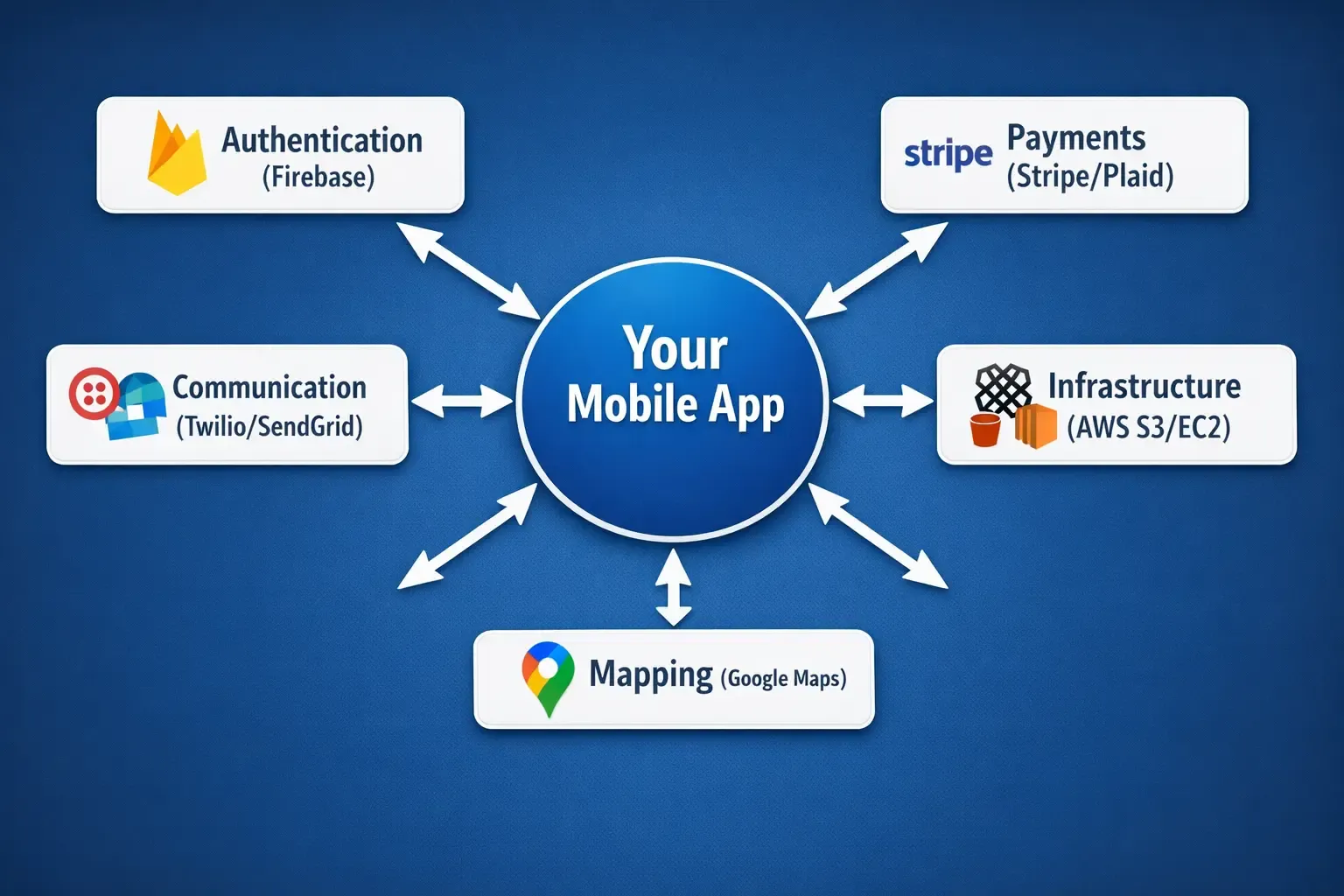
Fig 1: The 2026 standard technical architecture blueprint: Mapping the mandatory third-party API integrations required to validate and launch a functional mobile app MVP in the US market.
The 2026 Mobile App API Budget
Calculator
Stop guessing your monthly server costs. We built a customizable Google Sheet calculator
that models your exact API expenses based on your projected US user base. Input your
expected active users, and it instantly calculates your AWS, Stripe, Twilio, and OpenAI
overhead.
Forecasting Mobile App API Pricing for US Startups
Building every feature from scratch is financially impossible for most early-stage tech companies. If you want user authentication, you use Firebase or Auth0. If you need to send an email receipt, you plug in SendGrid. This method drastically reduces the initial software engineering hours required to launch.
Before committing to a heavy API architecture, founders must evaluate if they are actually ready to launch. If you are unsure, read our guide on When Your Startup Should Not Build a Mobile App (Yet).
The Hidden Costs of Third-Party APIs by Category (2026 USD Pricing)
Third-party API integration costs are rarely flat monthly fees. Most vendors use usage-based billing tiers. Below is a detailed breakdown of what US app developers actually pay to keep applications running.
1. Communication APIs: 2026 SMS and Email Pricing (US Regulations)
Every time your app interacts with a user outside the application interface, you pay a toll. Communication APIs are notorious for experiencing sudden billing spikes.
Twilio SMS Pricing USA
Twilio is the industry standard for sending SMS verification codes (OTP) and text notifications. In the US, the base price to send or receive a standard SMS is roughly $0.0079 per message segment.
However, the hidden costs appear in carrier surcharges and US telecommunications regulations.
- 10DLC Registration Cost: In the USA, you must register your business via the A2P 10DLC (Application-to-Person 10 Digit Long Code) system to prevent carrier blocking. This involves a one-time brand registration fee ($4 to $44) and a recurring monthly campaign fee ranging from $1.50 to $30.00. For US startups, compliance with A2P 10DLC (Application-to-Person 10-Digit Long Code) is mandatory. Beyond the $0.0079 base rate, you must budget for USD carrier surcharges from T-Mobile, Verizon, and AT&T, which add an average of $0.003 per message.
- Carrier Surcharges: Verizon, AT&T, and T-Mobile add a surcharge to every text, usually around $0.003 to $0.005 per message.
- Total Expected Cost: You should budget at least $0.012 per SMS sent to US users.
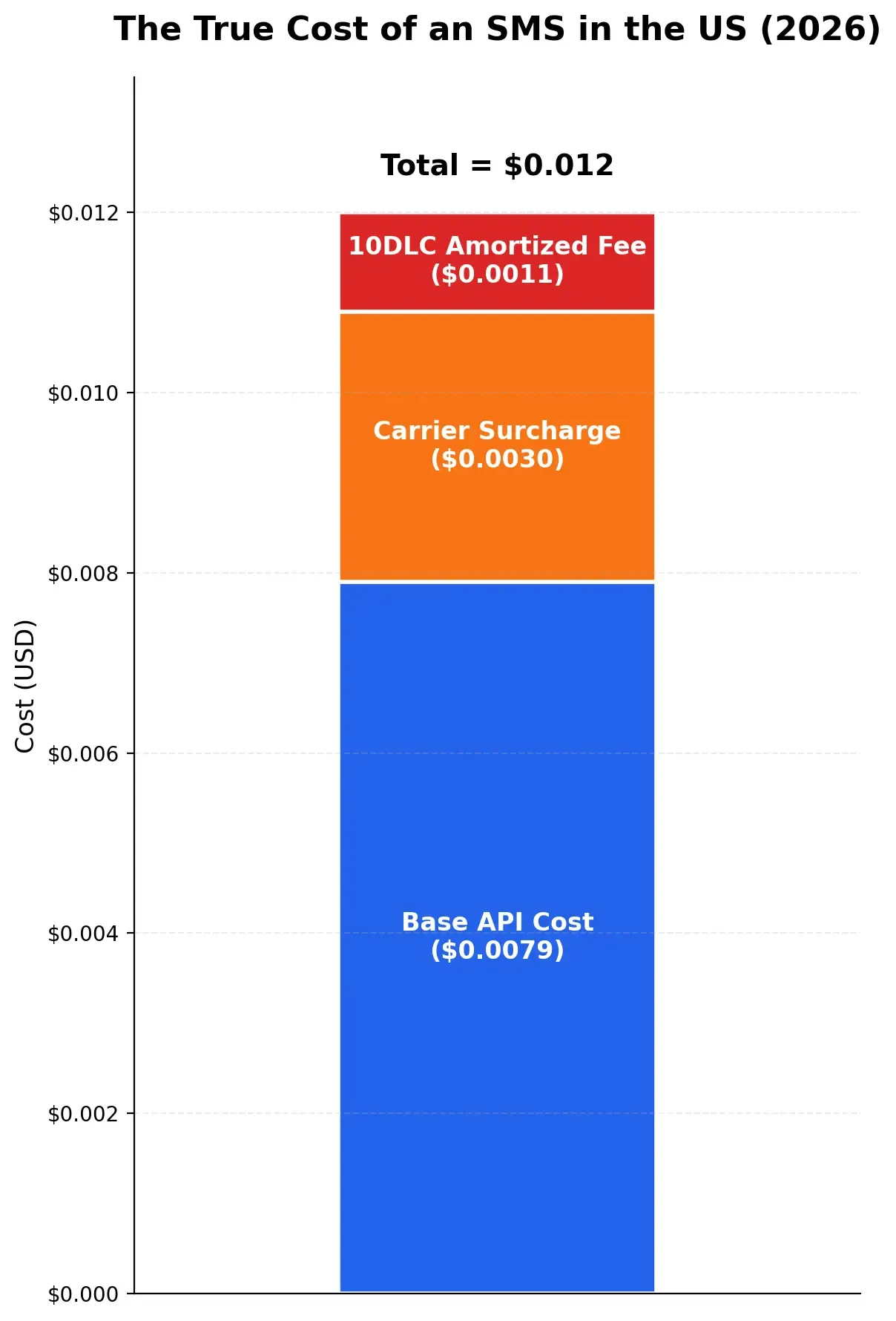
Fig 2: Hidden SMS variable costs for 2026: An accurate breakdown of US carrier surcharges and mandatory A2P 10DLC regulatory registration fees inflating your monthly marketing and security (OTP) budget.
SendGrid Transactional Email Costs
For password resets, onboarding emails, and purchase receipts, Twilio SendGrid is a top choice.
- Pricing: The Essentials plan starts at $19.95/month for up to 50,000 emails.
- Hidden Cost: Dedicated IP addresses (crucial to ensure your emails do not land in the spam folder) require the Pro plan, starting at $89.95/month.
Push Notification API Pricing
Apple and Google provide free push notification gateways (APNs and FCM). However, managing millions of tokens and targeting specific user segments requires a service like OneSignal.
- Pricing: OneSignal's Growth plan starts at $9/month, but costs rise rapidly based on the number of active subscribers. For an app with 10,000 active users, expect to pay around $45 to $80/month for advanced push infrastructure.
You can review the exact US pricing tiers directly on the Twilio Pricing Page.
2. Analyzing Mobile App API Pricing for US Market Leaders (Stripe, Twilio, AWS)
If your application generates revenue, payment gateway fees will be your largest operational expense. US startups heavily favor Stripe and Plaid for financial transactions due to their developer-friendly documentation and consumer trust.
Stripe Payment Gateway Fees
Stripe dominates the US payment processing landscape. Their standard pay-as-you-go pricing for processing credit cards in the US is: 2.9% + $0.30 per successful card charge. Stripe remains the gold standard for US-based merchants. Their standard pay-as-you-go pricing for domestic US card charges is 2.9% + $0.30 USD.
- Hidden Costs: If you are running a marketplace app (like Uber or Airbnb) where you collect money and pay out to independent contractors, you must use Stripe Connect. Routing money to connected accounts incurs additional fees: $2.00 per active account per month, plus 0.25% + $0.25 per payout. Dispute (chargeback) fees are $15.00 per lost dispute in the US.
- 2.9% + $0.30 per successful card charge.
- Dispute (chargeback) fees are$15.00per lost dispute in the US.
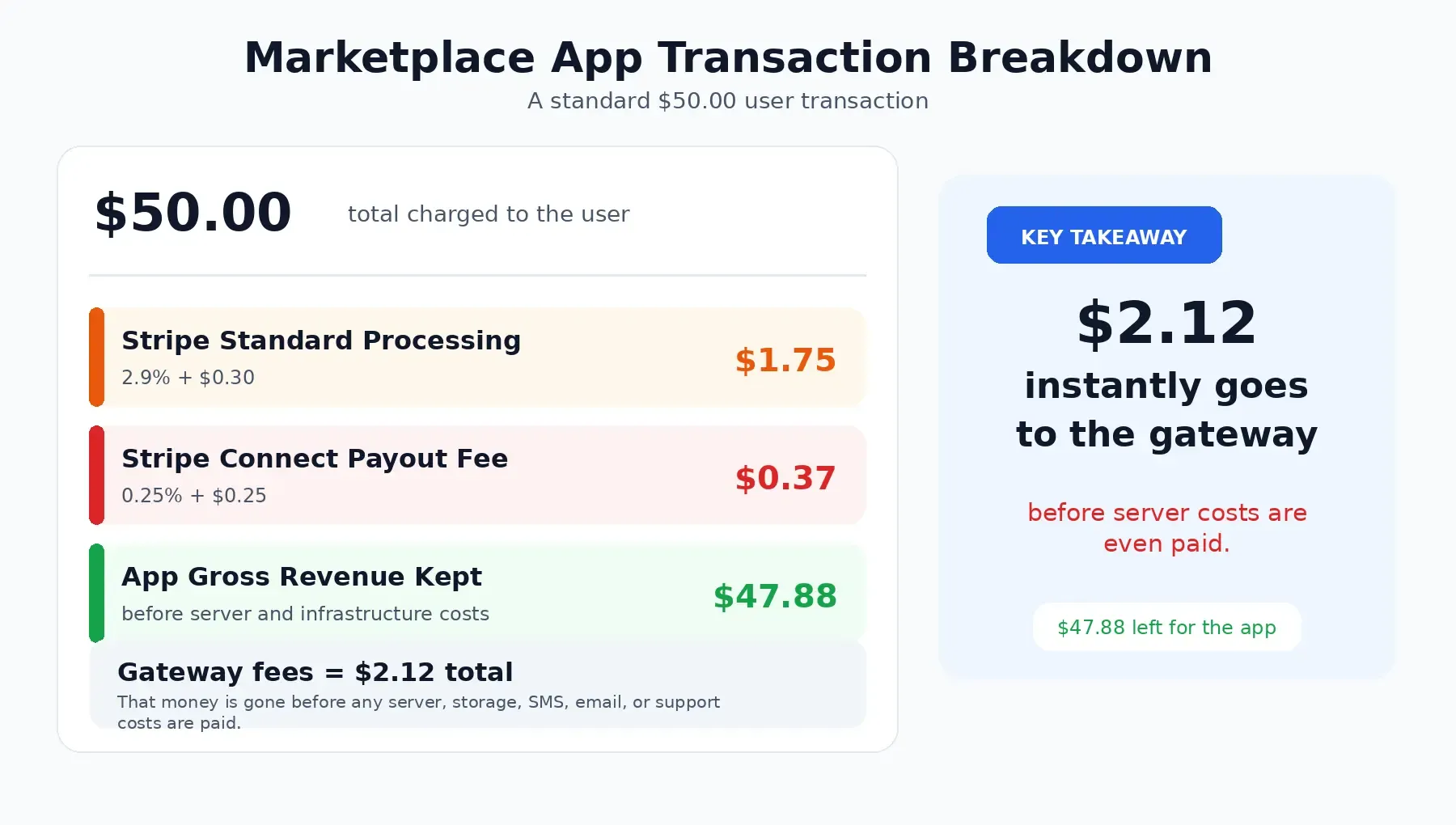
Fig 3: A financial analysis of mandatory financial integration overhead, including standard credit card processing and specific Stripe Connect marketplace fees for US operating entities.
Plaid API Integration Cost
If your app needs to connect directly to a user's US bank account for identity verification, checking balances, or facilitating ACH bank transfers, Plaid is the standard.
- Pricing: Plaid uses a complex billing model. Authenticating a bank account via Plaid Link costs an initial fee (often around $1.50 to $2.00 per linked account).
- Hidden Costs: Checking real-time balances or transaction history incurs an ongoing API call fee, usually a few cents per request. ACH transfer API fees via Plaid and Stripe combined will usually cost you 0.8% of the transaction amount (capped at $5.00).
To fully understand the labor costs required to implement these complex financial systems, review our detailed guide on Mobile App Development Cost in USA (2025).
3. Location and Mapping APIs: Google Maps and Mapbox
Apps relying on geolocation — delivery trackers, dating apps, or real estate platforms — consume massive amounts of map data.
Google Maps API Pricing Mobile App
Google Maps Platform offers a recurring $200 monthly credit to developers, which covers a small amount of basic usage. Once you exceed the free tier, costs accumulate fast. Google provides a recurring $200 USD monthly credit , but for US apps with high-volume geolocation needs, the Places Autocomplete API costs $17.00 per 1,000 requests once that credit is exhausted.
- Dynamic Maps (Mobile): Displaying dynamic maps natively on iOS and Android using the Google Maps SDK is currently free for unlimited loads.
- Hidden Costs (Places and Routing): The real expense comes from the Places Autocomplete API (when a user types an address and it auto-fills). This costs $17.00 per 1,000 requests. The Directions/Routing API costs $5.00 per 1,000 requests. A single user ordering food delivery might trigger 10 to 15 API calls as they search for an address, view the route, and track the driver.
Mapbox Routing API Fees
Many US startups choose Mapbox as a cost-effective alternative to Google. Mapbox gives you 100,000 free monthly route requests, followed by $4.00 per 1,000 requests. If your app architecture relies heavily on custom map rendering, Mapbox offers more predictable mapping API pricing.
4. Cloud Hosting and Backend APIs: AWS and Firebase
Firebase Database Pricing
Google's Firebase (specifically Cloud Firestore) is immensely popular for React Native and Flutter third-party libraries.
- Pricing: Firebase charges based on database reads, writes, and deletes. In US regions, it costs $0.06 per 100,000 document reads and $0.18 per 100,000 document writes.
- Hidden Costs: If an app developer structures the database poorly, a single screen load might request 500 documents instead of 10. This inefficient data fetching will drain your backend-as-a-service budget instantly.
Media Hosting: The AWS S3 Trap
Database reads and writes are only half the battle. If your mobile app allows users to upload profile pictures, short videos, or PDF documents, you need an object storage API. Amazon S3 (Simple Storage Service) is the default choice. While storing the data is cheap (roughly $0.023 per GB in US East), the hidden expense is the data egress fee — the cost of users downloading those images to their phones. If your app becomes a hit and users are swiping through thousands of high-res images daily, your AWS S3 bandwidth bill will easily eclipse your actual database storage costs.
The technology framework you choose directly impacts how your database queries are billed. React Native third-party API integration is highly efficient, but if not coded properly, it can trigger redundant backend calls. When founders ask about Flutter app backend pricing versus native Android server architecture, the answer usually comes down to database structure. Using a NoSQL database like Firebase might offer the cheapest database for mobile apps initially, but as your data becomes relational, migrating to a SQL setup increases your monthly app infrastructure bill. You must factor in data migration engineering hours and API downtime costs if you plan to switch from Google Cloud to AWS later. Understanding these app backend metrics ensures your database architecture matches your projected user growth.
AWS Infrastructure and Regional US Hosting Costs (2026)
Amazon Web Services (AWS) is the enterprise standard. When targeting a US user base, selecting the correct server location impacts both latency and cost. When optimizing your app development budget, region selection is key. Hosting in US-East-1 (N. Virginia) or US-East-2 (Ohio) typically offers the lowest latency and cost-per-instance for a national US audience compared to more expensive regions like US-West-1 (N. California).
- US East vs US West Latency AWS: Hosting your app infrastructure in US East (N. Virginia - us-east-1) is generally cheaper than US West (N. California - us-west-1). Compute instances and data transfer out to the internet carry slightly different price tags across regions. Data transfer out from US-East-1 costs $0.09 per GB, while US-West-1 may charge slightly more.
- Always choose US-East (Ohio or N. Virginia) for the lowest baseline costs unless your primary user base is strictly located on the West Coast requiring ultra-low millisecond latency.
AWS provides clear breakdowns of regional pricing differences on their AWS Pricing Calculator.
5. AI and Machine Learning API Expenses
Integrating artificial intelligence into your application is becoming mandatory for US user retention. However, OpenAI and Anthropic API connections run up high computing bills.
OpenAI Token Limits App Cost
Connecting your app to GPT-4o or GPT-4-turbo relies on token-based pricing. A token is roughly equivalent to 3/4 of an English word.
- Pricing: GPT-4o costs roughly $5.00 per 1M input tokens and $15.00 per 1M output tokens.
- Hidden Cost: If your app allows users to chat with an AI, the app must re-send the entire conversation history (context window) with every new message. This causes input token consumption to double and triple exponentially with long chats.
For a complete framework on when to actually integrate artificial intelligence, see our breakdowns: Does Your Startup Need AI in 2026? and 10 AI Features Mobile Apps Will Need in 2026.
Industry-Specific API Surcharges: Fintech and Healthcare
The baseline pricing above applies to standard consumer apps. However, if your startup operates in heavily regulated US sectors, your third-party service costs will look very different.
US Healthcare App API Costs: HIPAA and BAA Compliance
Standard servers and communication tools are not legally sufficient for patient data. To maintain HIPAA compliance, US healthcare apps cannot use base-tier services. For instance, standard Twilio SMS is not HIPAA compliant for transmitting Protected Health Information (PHI). You must upgrade to their Enterprise plan and sign a Business Associate Agreement (BAA). Similarly, hosting patient records requires dedicated, encrypted AWS instances rather than shared cloud environments, often pushing AWS server costs for healthcare startups past $1,500/month even with a small user base.
Fintech App API Costs (Financial Data and KYC)
Plaid and Stripe are just the beginning for fintech products. If you are building a neobank or a peer-to-peer lending app, you must integrate Know Your Customer (KYC) and Anti-Money Laundering (AML) APIs. Services like Persona or Onfido verify US driver's licenses and passports. These identity verification API costs run between $1.00 and $2.50 per successful verification. For a fintech app onboarding 1,000 new US users a month, KYC APIs alone will add $2,000 to your monthly operating expenses.
6. Analytics and App Monitoring APIs
You cannot fix bugs if you do not track them. However, tracking user behavior costs money.
- Mixpanel Event Tracking Fees: To track user clicks and funnel drop-offs, Mixpanel charges based on monthly tracked users or events. While the free tier handles 20 million events, advanced data modeling for growing US apps quickly pushes you into the $200+/month Growth plan.
- Sentry Error Tracking Budget: To monitor crashes in a React Native or iOS environment, Sentry is vital. It costs roughly $26 to $80/month, depending on how many crash events and performance spans you log.
Transitioning from a closed beta to a public launch changes your financial reality overnight. Founders frequently search for what it costs to host 10,000 active app users, expecting a linear increase. In reality, mobile app server pricing tiers are exponential. Your Stripe transaction fees for marketplace apps will multiply, and your Twilio SMS verification monthly budget will skyrocket as fake accounts try to register. This is the exact moment when optimizing third-party API calls becomes a matter of survival. You must audit your monthly active user infrastructure costs, track your average token consumption for AI features, and establish hard billing alarms on your AWS dashboard. Without these limits, a sudden spike in viral traffic will drain your app's operational budget in a matter of hours.
The 2026 API Cost Matrix: 1,000 vs 10,000 Active Users
Note: The table below uses baseline industry averages. To calculate the exact costs for your specific app's architecture and user flow, make a copy of our 2026 App API Budget Calculator
To help you with your software budget allocation in 2026, we have built a realistic cost matrix. This table projects the monthly third-party API costs for a typical US-based transactional application (such as an on-demand service, social marketplace, or SaaS utility tool).
Assumptions: Each active user sends 3 OTP SMS per month, triggers 10 transactional emails, processes 2 credit card payments of $50 each, performs 20 map searches, and interacts with the AI feature 15 times.
| API Service Provider | Purpose | Monthly Cost (1,000 Active US Users) | Monthly Cost (10,000 Active US Users) |
|---|---|---|---|
| AWS (US-East-1) | App Infrastructure Monthly Bill (EC2, S3, RDS) | $150.00 | $650.00 |
| Twilio | SMS OTP & Notifications (~$0.012/msg) | $36.00 | $360.00 |
| SendGrid | Transactional Emails | $19.95 | $89.95 |
| Stripe | Payment Gateway Fees (2.9% + $0.30) | $3,500.00 | $35,000.00 |
| Plaid | Bank ACH Link Authentication | $50.00 | $400.00 |
| Google Maps API | Places Autocomplete & Routing | $0.00 (within $200 free tier) | $350.00 |
| OpenAI | AI Features Mobile App Cost (Tokens) | $85.00 | $850.00 |
| Sentry / Mixpanel | Crash Tracking & Analytics | $29.00 | $280.00 |
| Total Estimated Operating Cost | Excluding app update costs | $3,869.95 / month | $37,979.95 / month |
Note: The vast majority of the $37k expense at the 10,000 user tier is Stripe processing fees. While this is technically revenue-dependent, it represents money instantly removed from your gross margin.
Visualizing Your Budget: Average Monthly API Expenses
For a standard US startup with 10,000 active users, here is how those costs are typically distributed:
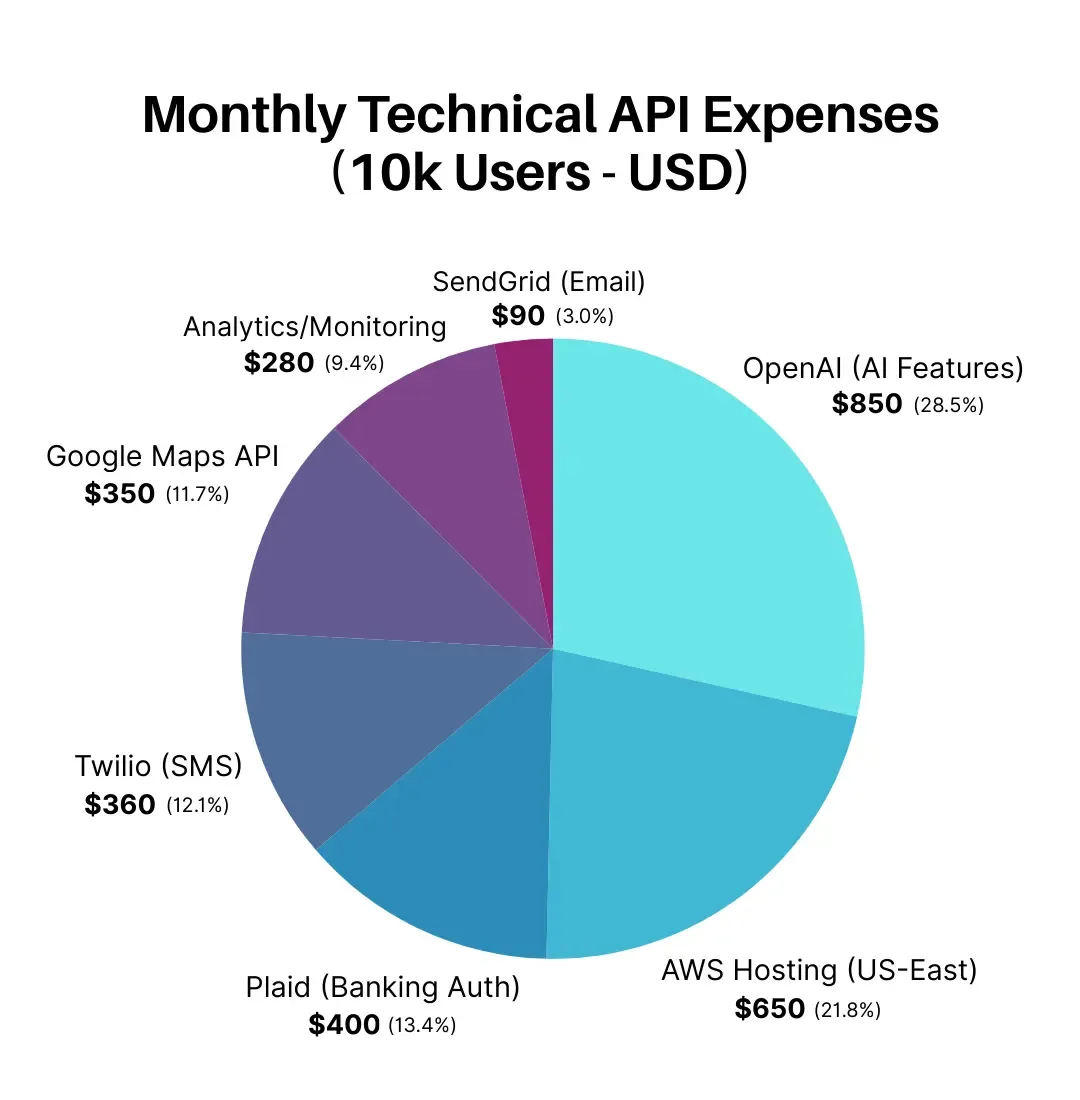
Fig 4: Estimated 2026 monthly app infrastructure costs for a transactional platform serving 10,000 active users in the US East region.
Beyond the Subscription: The Hidden Technical Costs
When founders calculate their mobile app development budget USA, they look at the vendor pricing pages and stop there. But the real hidden costs of third-party APIs lie in human engineering hours.
1. The Cost of API Integration and Setup
Connecting an API takes development time. Integrating Stripe into a React Native application requires setting up secure backend webhooks, handling test environments, and passing PCI compliance checks. A mid-level US app developer charges between $80 to $150 per hour. Spending 40 hours integrating complex payment architectures adds $3,200 to $6,000 to your upfront React Native app development cost.
Integrating complex microservices requires senior engineering talent. If you are a US founder looking to build a high-performance application without the technical debt, explore our Mobile App Development Services to see how we structure scalable codebases from day one.
If you are trying to estimate these initial engineering hours accurately, read our specific breakdown on React Native App Development Cost in the USA (2026).
2. Version Deprecation and App Update Costs USA
APIs do not stay the same forever. Vendors release new API versions and deprecate old ones. When Stripe updates its API to enforce new security protocols (like SCA in Europe or new US fraud prevention rules), your code will break if you do not update it.
Maintaining these connections requires a monthly retainer with your development team. Read our full analysis of App Maintenance Cost USA 2026: Monthly Retainers, Update Costs, Benchmarks to budget for these inevitable software patches.

Software is a living entity, and vendor dependencies require constant babysitting. When estimating post-launch app support packages, you must account for mandatory third-party API updates. If Google changes its mapping SDK or Apple alters its push notification protocols, your app will crash. This is why securing a monthly app maintenance retainer is non-negotiable. This retainer covers routine mobile app bug fixes, operating system compatibility updates, and security patch integration for third-party tools. Trying to handle emergency API deprecation fixes by hiring hourly freelancers often results in higher long-term software technical debt. A structured post-launch development roadmap ensures your integration remains secure without unpredictable billing spikes.
3. Third-Party Lock-in Risks
When you build your entire user authentication system on Firebase, your database architecture becomes heavily reliant on Google's proprietary structure. If Firebase suddenly triples its database read pricing, migrating thousands of user profiles to an independent AWS PostgreSQL database will require massive engineering efforts and cause application downtime. Data migration fees and rebuilding backend-as-a-service structures are some of the most expensive hidden API expenses a company can face.
Optimizing Your 2026 App Development Budget
You cannot avoid third-party API costs entirely, but smart architecture choices can slash your monthly app infrastructure bill by 40% to 60%.
Cache Your Data to Prevent Redundant Calls
If a user opens your app and looks at a list of local restaurants, your app should not query the Google Maps API every single time they refresh the screen. By implementing caching on the device (using AsyncStorage in React Native or Room in Android), your app saves the data locally. You only pay the API fee once, rather than paying for 10 identical requests in five minutes.
Webhooks vs. Long Polling
Never use long polling (where your app constantly asks a server "Is the data ready yet?" every few seconds). This racks up millions of useless backend server hits, inflating your AWS US East hosting costs. Instead, use Webhooks. The third-party API will independently notify your server the exact millisecond an event occurs (e.g., a Stripe payment clearing).
Consolidate Your SMS Delivery
Do not send an SMS if an in-app push notification will suffice. Push notifications via APNs are virtually free compared to Twilio's $0.012 per SMS. Reserve Twilio strictly for critical security alerts (two-factor authentication) and route all marketing and engagement messages through Push or SendGrid emails.
Cap Your OpenAI Token Limits
If you integrate Anthropic Claude API pricing or OpenAI into your mobile application, set strict maximum token limits in your API calls. Hardcode an absolute limit on user queries per day to prevent a single power user (or a malicious bot) from draining your AI features mobile app cost budget overnight.
Building In-House vs. Buying APIs: The Breakeven Point
At what point does it make financial sense to stop paying Plaid, Twilio, or Firebase and build a custom backend from scratch?
For early-stage startups in 2026, the answer is usually: never in the first two years.
The upfront salary cost of hiring specialized US app developers to build a proprietary mapping routing engine or a custom communication protocol far exceeds the $1,000/month you pay external vendors.
However, as you approach tens of thousands of users, the mathematics change. A custom backend vs BaaS (Backend as a Service) argument becomes valid. When your Firebase monthly bill exceeds $3,000, it is time to migrate to a self-managed AWS or DigitalOcean infrastructure to regain control over your profit margins.
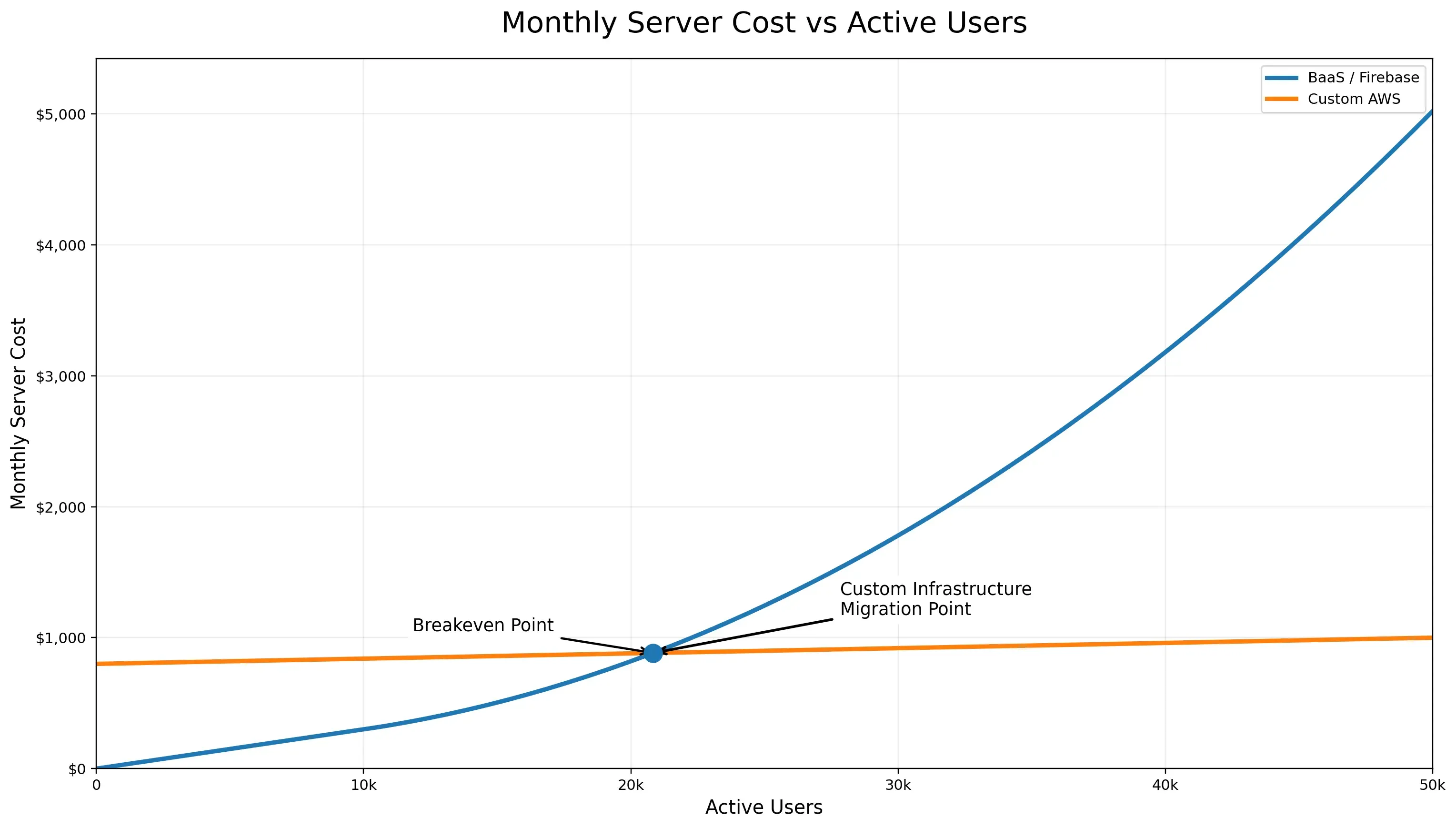
Fig 5: Scaling comparison chart: The intersecting breakeven point where custom AWS infrastructure becomes more cost-effective than a Backend-as-a-Service (BaaS) like Firebase for scaling US apps.
Choosing who builds and manages this migration is another critical decision. Should you hire a full-time CTO, a specialized agency, or a group of Upwork freelancers? We detail the exact pros and cons for the US market in our guide: In-House vs Agency vs Freelancers: How US Startups Build Mobile Apps.
Before you commit to a custom backend, you need to see how similar platforms have solved this problem. Browse our Portfolio to see case studies of how we have optimized API architectures for high-growth startups.
Finalizing Your 2026 App Development Budget: Avoiding the API Scaling Trap
Understanding your mobile app API pricing in 2026 requires looking past the glossy landing pages of software vendors. The hidden fees, carrier surcharges, document read counts, backend latency charges, and engineering update hours are what dictate your true monthly app expenses.
By carefully choosing your third-party integrations, building an efficient caching architecture, and monitoring your monthly API cost matrix, US startups can launch software without burning through their runway. Before you write a single line of code, establish hard monthly limits on your AWS accounts and clearly define your monetization strategy to offset payment gateway fees.
If you are a US startup founder looking for an experienced technical partner to help you build a cost-optimized mobile architecture, review our Checklist for Choosing the Right Mobile App Development Partner and reach out to the Budventure team to map out your 2026 development roadmap.
Sources and US Pricing References (2025/2026 Data)
Source: Twilio SMS Pricing and A2P 10DLC Regulations
Source: Stripe Pricing and Billing
Source: Amazon Web Services Pricing Calculator
Source: OpenAI API Pricing
FAQ About Mobile App API Costs
Starting a new project or
want to collaborate with us?