

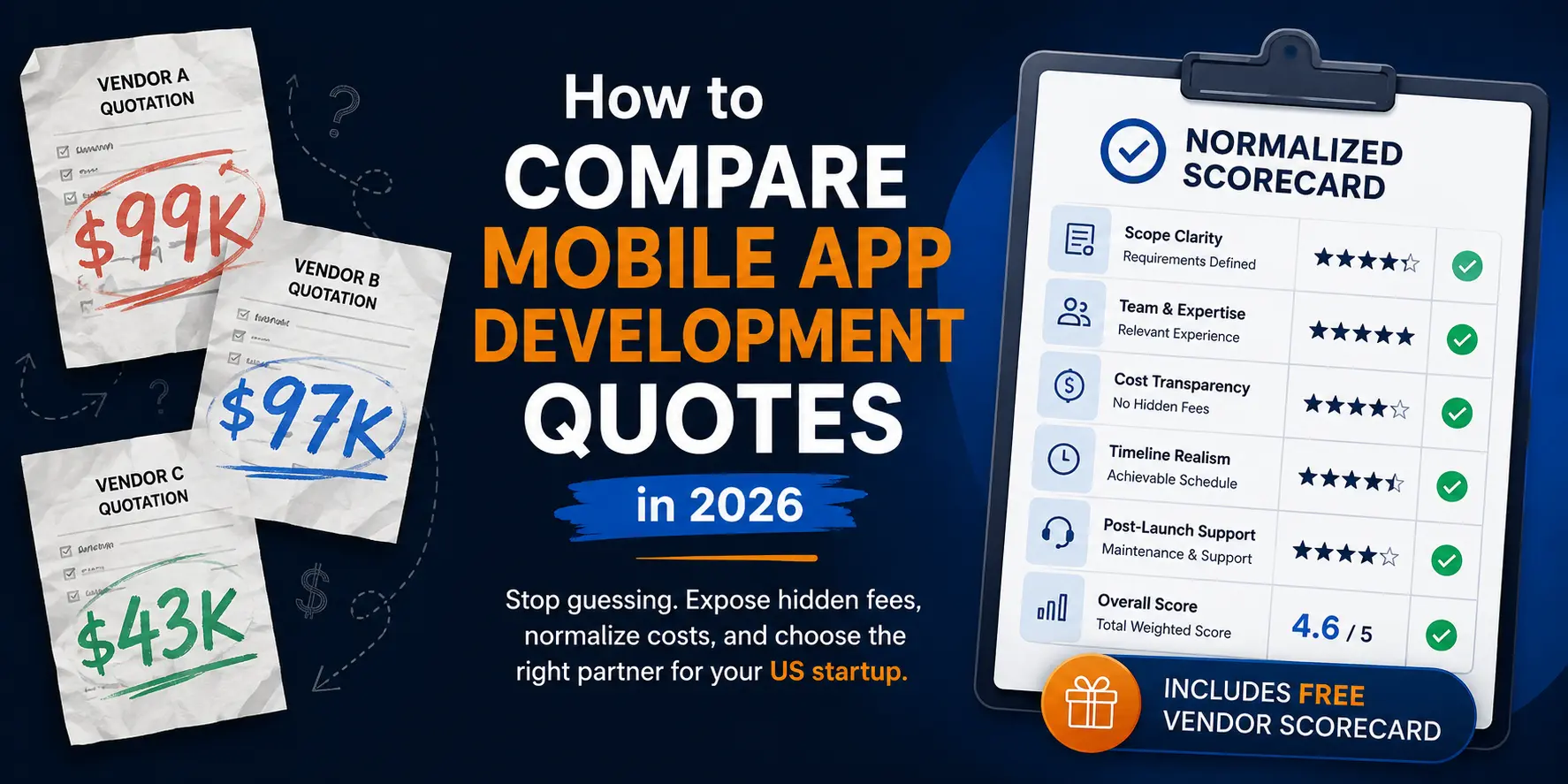
How to Compare Mobile App Development Quotes in 2026: A Free Vendor Scorecard for US Startups
You send the same app brief to three development companies and receive three very different proposals:
- One agency quotes a fixed price of $99,000.
- A second estimates $97,500 using an hourly or time-and-materials model.
- A third promises to build the app for $43,000.
The cheapest proposal looks like the obvious winner. It may also be the most expensive proposal once you add the work it omitted.
Mobile app development quotes are rarely directly comparable. One vendor may include product discovery, UI/UX design, backend engineering, QA, DevOps, analytics, store submission, and post-launch support. Another may quote only the visible mobile screens. A third may include everything in principle but leave the scope vague enough that major features later become paid change requests.
The right question is not, Which app development quote is lowest?
It is:
Which proposal gives us the clearest, most credible path to a launchable product at a controlled total cost?
Founders rarely overspend because one quote was obviously expensive. They overspend because different vendors price different versions of the same product. A reliable comparison starts by putting fixed-price and hourly estimates on the same basis, exposing omitted work, checking source code and IP terms, and testing API, security, handover, and, where relevant, HIPAA responsibilities before a contract is signed. A weighted score then makes the trade-offs visible instead of allowing the lowest headline price to decide the project.
The Quick Answer: How to Compare App Development Quotes
Before choosing a mobile app development company, put every proposal into the same structure:
- Define the exact product scope being compared.
- Send the same brief and supporting information to every shortlisted vendor.
- Separate included, excluded, optional, and unclear work.
- Convert fixed-price and hourly quotes into a comparable planning total.
- Add realistic allowances for omitted work, third-party costs, and uncertainty.
- Score each vendor’s delivery capability, QA, security, ownership terms, communication, and relevant experience.
- Have at least two stakeholders score each proposal independently before discussing the results.
- Require evidence for important claims, including case studies, references, team experience, and delivery processes.
- Review the contract, IP assignment, account ownership, source-code access, and handover terms before signing.
- Request a full mobile app development cost breakdown so you can compare line items, not just the final price tag.
Price matters, but price should be evaluated after scope and risk have been normalized, not before.
Teams still deciding whether an app is the right product should first read When Your Startup Should Not Build a Mobile App Yet. Teams that have committed to mobile development can use Budventure’s App Development Cost Calculator for the USA to create a first-pass budget before reviewing vendor proposals.
Compare App Development Quotes on Equal Terms
Download our free scorecard and app development proposal template to normalize costs, flag missing scope, and score vendors side by side.
Why Quotes Differ and How to Make Them Comparable
A large difference between proposals does not automatically mean one company is overcharging and another is offering a bargain. Quotes often vary because vendors price different interpretations of the same idea and because they operate in vastly different geographical markets. For example, a $43,000 quote might rely entirely on an offshore development team, whereas a $99,000 quote might reflect a fully US-based or hybrid team with higher local overhead.
A short brief such as build a marketplace app with payments and chat leaves dozens of unanswered questions:
- Which user roles are included?
- Are the backend and admin dashboard part of the scope?
- Will the app support iOS, Android, or both?
- Which payment, messaging, identity, and other integrations are required?
- What QA, analytics, security, and release work is included?
- What support is expected after launch?
One vendor may make conservative assumptions and price the complete operating product. Another may estimate only the happy-path screens shown in a sales call. Both can claim they quoted the app.
This is why a useful mobile app development proposal needs more than a total price. It should explain the scope, deliverables, assumptions, exclusions, team, timeline, dependencies, testing approach, commercial model, and post-launch responsibilities.
One-Page App Quote Comparison Checklist
You cannot fairly compare three proposals when each vendor is solving a different version of the project.
Create a one-page comparison baseline before reviewing prices. It should define:
- The primary user groups
- The core user outcome
- The must-have MVP workflows
- The supported platforms
- The backend and admin requirements
- Required integrations
- Security or regulatory constraints
- Expected launch window
- Post-launch support expectations
- Explicit out-of-scope features
This does not need to be a complete technical specification. It only needs enough clarity to expose material differences in vendor assumptions.
For a complex or uncertain product, a paid discovery phase may be more credible than an immediate fixed quote. Discovery should produce usable outputs such as prioritized requirements, user flows, architecture decisions, integration findings, acceptance criteria, delivery risks, and an updated estimate.
A vendor that recommends discovery is not necessarily adding unnecessary cost. It may be refusing to hide uncertainty inside an unreliable fixed price.
Before requesting quotes, compare the trade-offs among in-house teams, agencies, and freelancers. The right evaluation criteria change depending on whether you are buying a managed outcome, individual engineering capacity, or a permanent internal capability.
Fixed-Price vs Hourly App Development Proposals
Fixed-price and hourly contracts allocate project risk differently. Neither model is automatically safer or less expensive.
Fixed-Price Proposal
A fixed-price proposal works best when the scope, deliverables, dependencies, and acceptance criteria are clearly defined.
Its main risk is that the price may be fixed only for the vendor’s interpretation of the requirements. Unclear features can later become paid change requests, while pressure to protect the vendor’s margin may reduce testing, documentation, or implementation depth.
Ask:-
- What exact deliverables and exclusions support the quoted price?
- Which assumptions were used to create the estimate?
- How are scope changes identified, approved, and priced?
- What acceptance criteria must be met before each payment is released?
Hourly or Time-and-Materials Proposal
An hourly model can work well when the product is evolving, technical uncertainty is high, or the startup expects to reprioritize features during development.
Its main risk is weak cost control. An hourly contract without budget checkpoints, delivery evidence, and approval rules can continue consuming budget without producing a predictable outcome.
Ask For:-
- Estimated hours and cost by phase or role
- Weekly team allocation and progress reporting
- A target budget or not-to-exceed review point
- Approval before the estimate exceeds an agreed threshold
Use this planning formula for every vendor:
Normalized planning total = headline quote + estimated omitted work + expected pass-through costs + uncertainty allowance
A detailed fixed-price proposal may justify a smaller uncertainty allowance. An early hourly estimate or a low fixed quote with missing QA, DevOps, analytics, or handover work may require a larger allowance.
The purpose is not to predict the final cost perfectly. It is to avoid comparing a complete proposal with an incomplete one.
Still establishing a realistic starting budget? Use Budventure’s Free US App Development Cost Calculator before comparing vendor proposals.
Three Differently Structured Mobile App Quotes
Assume a US startup is building a two-sided mobile marketplace with user accounts, listings, search, payments, notifications, an admin dashboard, analytics, and iOS and Android delivery. Founders often ask about the average cost to develop an app in the USA, but as this scenario shows, the answer depends entirely on who is defining the scope.
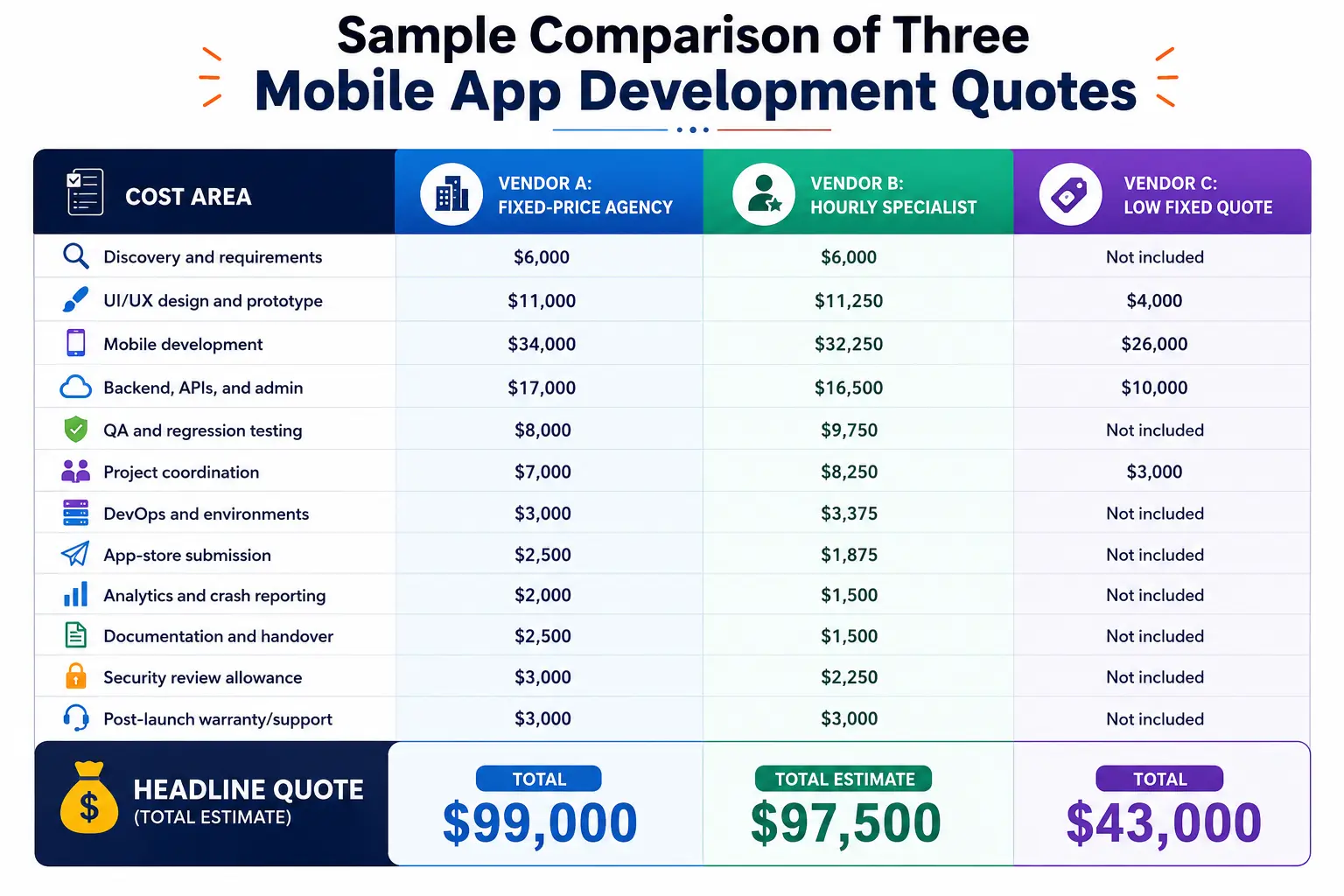
At first glance, Vendor C appears to save more than $50,000.
Now normalize the proposals.
For Vendor C, a conservative allowance for the missing discovery, QA, DevOps, store submission, analytics, handover, security review, and warranty work adds approximately $29,000. That produces a pre-buffer comparable total of $72,000. Applying a 20% uncertainty allowance creates a normalized planning total of approximately $86,400.
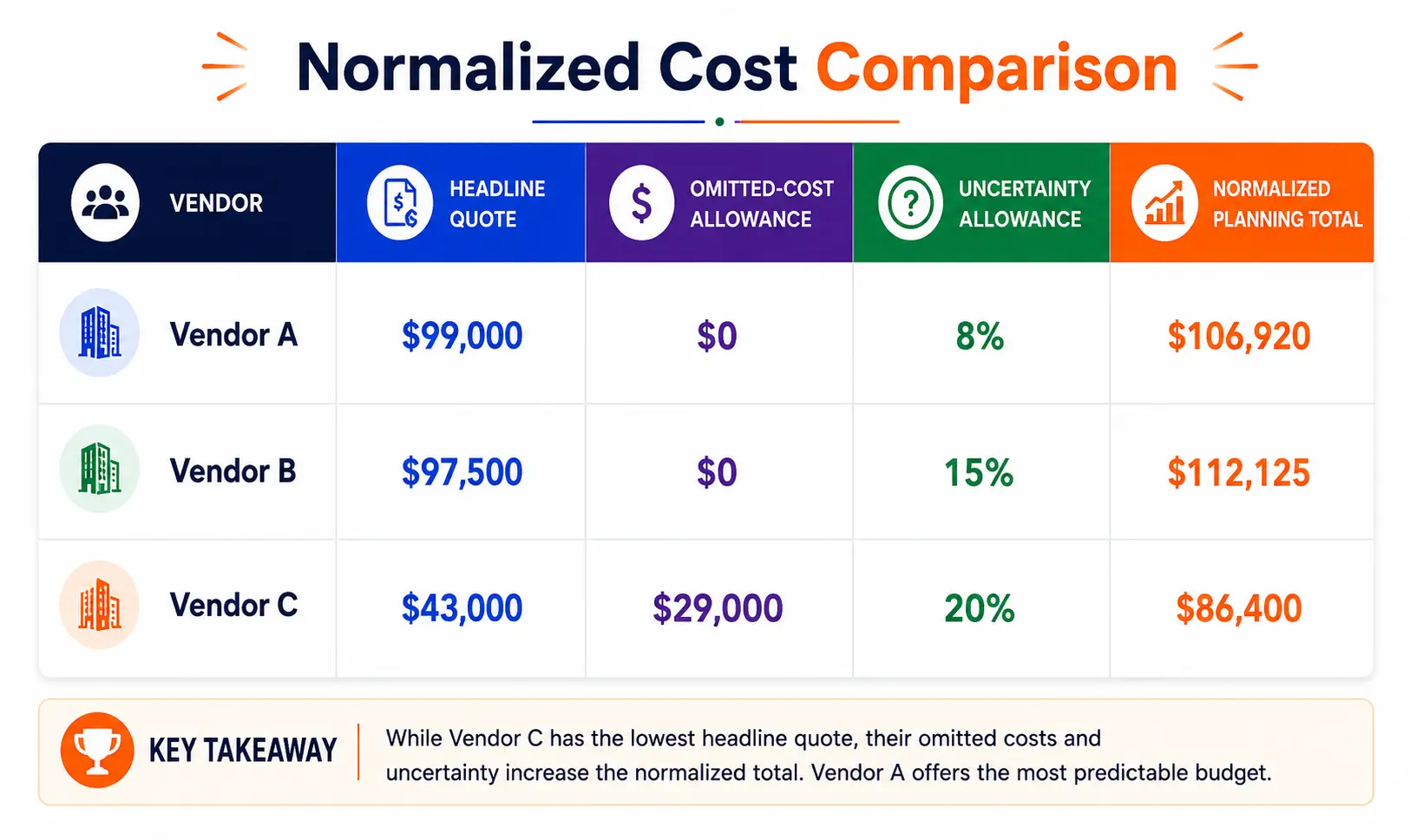
Vendor C is still less expensive in this illustration, but the real gap is about $20,000, not $56,000. More importantly, its proposal carries substantially more delivery, quality, ownership, and handover risk.
This changes the decision. A founder can now ask whether the remaining savings justify the operational risk, rather than being misled by the headline price.
The Line Items Commonly Missing from App Development Quotes
To avoid the hidden costs of app development, your evaluation checklist must test every phase required to move from an idea to a stable production release. A strong app development quote checklist should test every phase required to move from idea to a stable production release.
1. Product discovery and requirements
Discovery may include stakeholder workshops, user roles, workflow mapping, feature prioritization, technical research, acceptance criteria, and a risk register.
When discovery is missing, the vendor may be estimating against unspoken assumptions. The cost does not disappear. It returns later as rework, delay, or change orders.
Ask what tangible discovery deliverables you will own if you stop after that phase.
2. UI/UX design
Design included is too vague.
Confirm whether the proposal includes:
- User flows
- Low-fidelity wireframes
- High-fidelity interfaces
- A clickable prototype
- Design-system components
- Responsive states where needed
- Empty, loading, error, and permission states
- Accessibility considerations
- Developer handoff
- App-store screenshots and visual assets
For products where usability is a major business risk, review Budventure’s mobile app UI/UX design services and make design deliverables explicit before estimating development.
3. Backend, admin, and data work
Some inexpensive quotes price only the mobile interface.
Confirm whether the estimate includes:
- Database design
- Authentication and authorization
- APIs
- Business logic
- Admin dashboards
- User-management tools
- Reporting and exports
- Notification services
- File storage
- Search
- Audit logs
- Backups
- Data migration
- Documentation
A visually complete app without a production-ready backend is not a completed product.
4. QA and release testing
Developers will test their work is not a QA strategy. Ask for the planned device matrix, operating-system coverage, regression process, test environments, defect reporting, user-acceptance support, release criteria, and evidence delivered before launch.
Security-sensitive apps should also define a mobile security baseline. The OWASP Mobile Application Security Verification Standard provides a recognized structure for mobile security requirements and testing. citeturn829980search2
5. DevOps, environments, and monitoring
A proposal should say who sets up and owns:
- Development, staging, and production environments
- CI/CD pipelines
- Cloud infrastructure
- Secrets and credentials
- Monitoring and alerts
- Logging
- Crash reporting
- Backups
- Restore procedures
- Rollback plans
- Domain and certificate management
These are not optional extras for a production app.
6. Apple App Store and Google Play release work
Confirm whether the vendor includes:
- Store-account setup guidance
- Certificates and signing
- Build packaging
- Privacy disclosures
- Store listings
- Screenshots
- Review submissions
- Rejection support
- Production rollout
The client company should normally control its developer accounts, cloud accounts, repositories, analytics, and critical third-party services. Apple and Google both support formal app-transfer processes, but relying on a later transfer creates avoidable operational work and can introduce eligibility or policy complications. Apple explains App Store Connect transfers here, and Google documents Play Console app transfers here.
7. Analytics, consent, and crash reporting
Analytics is often mentioned but not scoped. Ask which events, user properties, funnels, retention metrics, dashboards, consent controls, and crash-reporting tools are included. Confirm who pays the software fees and who owns the accounts and data.
A startup should be able to measure whether users complete the product’s core action after launch. Installing an analytics SDK without an event plan is not enough.
8. Maintenance and post-launch support
Launch is the start of production responsibility.
Clarify:
- Warranty length
- What qualifies as a defect
- Response times
- Critical-incident coverage
- Operating-system update support
- Dependency updates
- Security patches
- Hosting responsibility
- Monitoring responsibility
- Maintenance retainers or hourly rates
- Knowledge-transfer expectations
A Weighted Vendor-Evaluation Model for Mobile App Development
A scorecard prevents the cheapest quote, best salesperson, or most attractive portfolio from dominating the decision without evidence. Think of this downloadable scorecard as your ultimate checklist to level the playing field, ensuring every vendor is judged against the exact same baseline.
Use a 1–5 scale, where:
- No credible evidence or unacceptable risk
- Weak evidence with major gaps
- Adequate but not differentiated
- Strong evidence with minor gaps
- Exceptional evidence and low execution risk
Recommended weights for a startup mobile app project:
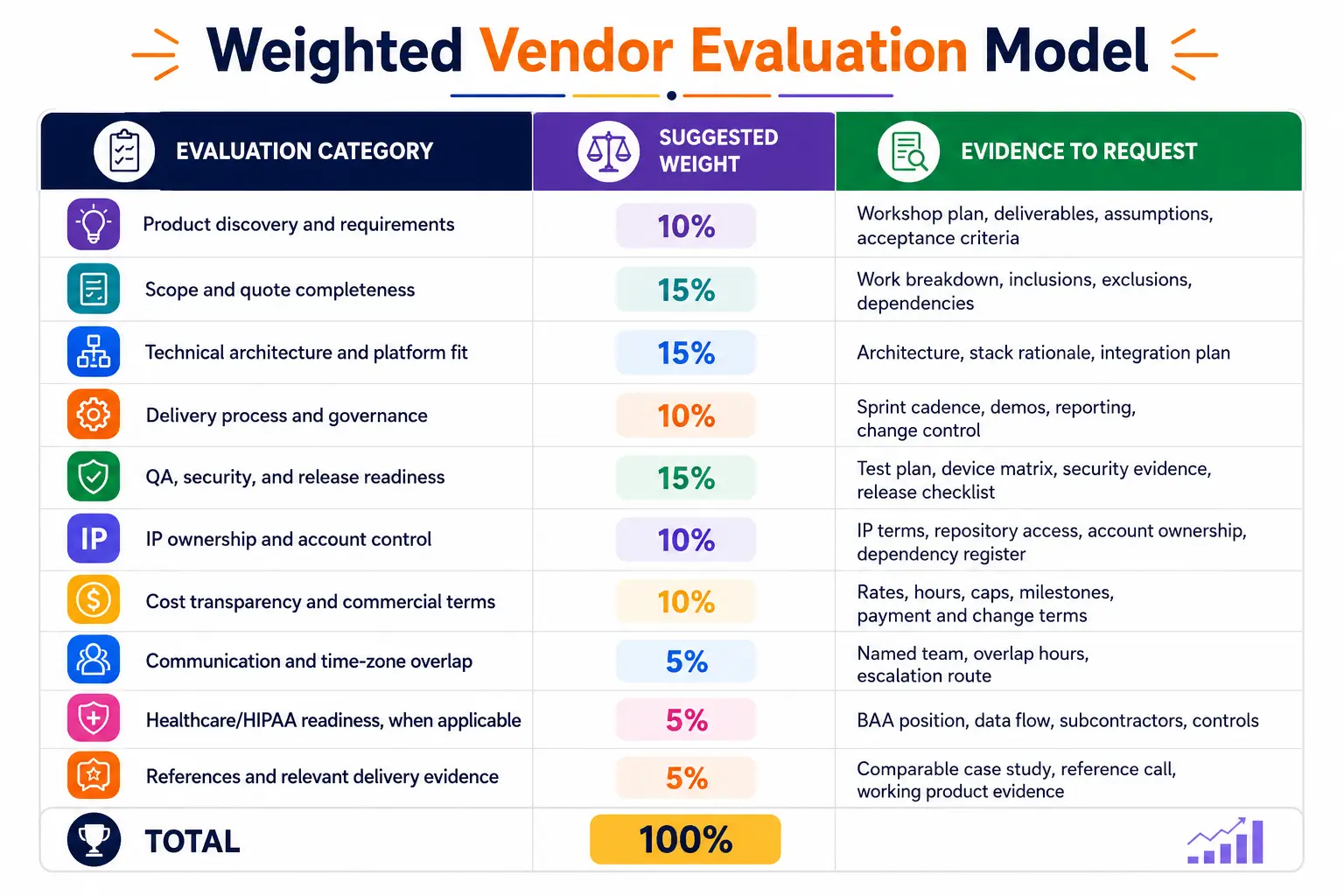
Do not allow vendors to self-score. Have at least two stakeholders score independently, then discuss material differences. A technical reviewer may detect architecture risk that a founder misses. A product leader may detect a weak discovery approach that procurement overlooks.
The score does not make the decision automatically. It forces the team to explain the decision using the same criteria.
Budventure’s existing guide to choosing a mobile app development partner can support readers who are still creating a shortlist rather than comparing final proposals.
IP Ownership, Source-Code Access, and Handover Questions
Founders often hear “you will own the app” and assume every ownership issue has been resolved. In practice, the product depends on more than the visible source code.
The agreement should clearly address ownership and access for:
- Custom source code and reusable vendor components
- UI/UX designs and design-system files
- Technical documentation and database structures
- Build scripts, infrastructure, and deployment configuration
- App-store, cloud, domain, analytics, and payment accounts
- Open-source and commercial dependencies
- Client data, credentials, and other project assets
Do not assume that paying the final invoice automatically gives the startup every right, file, account, and credential it needs. The contract should define these items explicitly and should be reviewed by qualified counsel.
Ask every vendor:
- Who owns the custom code, designs, and documentation after payment?
- Which pre-existing vendor components remain vendor-owned, and what license will the client receive?
- Will the client receive repository access throughout the project rather than only at the end?
- Will app-store, cloud, domain, analytics, messaging, and payment accounts be created under the client’s control?
- Which open-source, commercial, or third-party dependencies will the product rely on?
- What documentation, build instructions, credentials, and infrastructure files are included in handover?
- What transition support will be provided if another team takes over the product?
A good mobile app handover is not a ZIP file. It is the transfer of the technical and operational capability required to build, release, monitor, support, and change the product.
Questions to Ask About Third-Party APIs
Third-party services can accelerate a project, but they also create recurring cost, policy, reliability, privacy, and lock-in risks.
Common app dependencies include payments, maps, messaging, video, identity verification, email, push notifications, AI models, analytics, search, cloud storage, and healthcare integrations.
For every material API, ask:
- How is pricing calculated?
- What usage assumptions support the estimate?
- Who owns the account?
- What data is shared?
- What happens during downtime?
- How difficult is replacement?
- Are usage alerts and limits included?
Read The Hidden Costs of Third-Party APIs in Mobile Apps before accepting a proposal that treats every integration as a one-time development line item.
Warning Signs in Unusually Cheap App Development Proposals
A cheap proposal can be legitimate. A focused team, reusable capability, offshore delivery model, narrower scope, or cross-platform architecture may reduce cost. The problem is not a low number. When you request a custom app development quote, a low price can be legitimate if the vendor utilizes reusable capabilities or an offshore delivery model. However, a low number that cannot be explained is a major red flag.
Treat these as warning signs:
One total with no work breakdownYou cannot identify omissions, compare vendors, or control changes when every activity is hidden in one number.
A fixed price after one short callA vendor cannot credibly guarantee an uncertain product without making aggressive assumptions, reducing scope, or planning for later change orders.
No exclusions sectionEvery proposal has boundaries. A proposal that shows none is hiding assumptions rather than removing them.
QA means only developer testingDevelopers should test their work, but independent regression, device coverage, edge cases, and release evidence still need ownership.
No backend, DevOps, analytics, or admin allowanceThe quote may be pricing screens rather than an operable product.
The vendor owns critical accountsThis creates avoidable dependency during release, billing, handover, fundraising, acquisition, or a vendor dispute.
Source code arrives only after final paymentThe client has no continuous evidence of progress and faces greater continuity risk near the end of the project.
The quote is precise while the scope is vaguePrecision in the total does not compensate for ambiguity in the work.
The vendor refuses to show the delivery teamThe people presented during sales may not be the people building the product.
Security is postponed until launchSecurity requirements affect architecture, data handling, access, logging, and testing. They cannot be reliably added as a final-day checklist.
Healthcare and HIPAA: Additional Checks for Healthcare Projects
Healthcare app development requires more than adding HIPAA-compliant to a proposal.
HIPAA applicability depends on the parties, the relationship, the data, and the functions being performed. The US Department of Health and Human Services provides specific health-app scenarios explaining when an app developer may be acting as a business associate. HHS also states that covered entities and business associates generally need appropriate contracts with business associates to safeguard protected health information. Review HHS resources for mobile health app developers and its sample Business Associate Agreement provisions.
This section is an evaluation checklist, not legal advice.
A healthcare proposal should address:
- PHI data flow
- BAA responsibility
- Subcontractors
- Access controls
- Encryption and device storage
- Audit logs
- Incident response
- Retention, deletion and handover
Do not accept that we use a HIPAA-compatible cloud as a complete answer. Infrastructure is one part of the operating system around the application.
Founders planning a telehealth product should also review How to Build a HIPAA-Compliant Telemedicine MVP for the US Market. Budventure’s DocForUs medical app case study can be linked where relevant, provided every claim on the case-study page is verified and supported internally.
A Practical Vendor-Comparison Process for Startup Teams
Use this sequence to prevent bias and wasted sales calls.
Step 1: Create the baseline brief
Define the users, core workflows, platforms, integrations, admin needs, constraints, and MVP boundaries.
Step 2: Send the same information to every shortlisted vendor
Do not give one vendor a detailed workshop and another a two-paragraph email, then compare their totals.
Step 3: Require a standard proposal response
Ask each vendor to separate:
- Included work
- Excluded work
- Optional work
- Client responsibilities
- Third-party costs
- Assumptions
- Dependencies
- Risks
- Change-control rules
Step 4: Run clarification calls
Use the same core questions for every vendor. Record evidence, not impressions.
Step 5: Normalize cost
Convert the proposals into common cost categories. Add reasonable allowances for omitted work and uncertainty.
Step 6: Score independently
Have product, technical, and commercial stakeholders score the vendors before discussing the results.
Step 7: Verify claims
Review relevant work, speak to references, meet the delivery team, and inspect sample documentation or reporting.
Step 8: Review contract and ownership
Use qualified legal counsel for IP, confidentiality, liability, privacy, security, payment, termination, and dispute terms.
Step 9: Start with a controlled first phase
For a high-uncertainty product, a defined discovery or prototype phase can test the working relationship before committing the full build.
Teams that already know their preferred stack can review Budventure’s React Native development services and 2026 React Native cost guide for the USA. The framework choice should follow product requirements, not be used as a shortcut around proper scope definition.
Final Checklist Before Signing An App Development Proposal
Before approving a vendor, confirm that you can answer “yes” to the following:
- We compared the same scope across vendors.
- We separated included, excluded, optional, and unclear work.
- We normalized fixed-price and hourly proposals.
- We modeled omitted and recurring costs.
- We understand the change-control process.
- We know the actual delivery team.
- We have reviewed QA, security, and release responsibilities.
- We control critical accounts and have repository access.
- IP ownership and licensing are explicit in writing.
- Third-party API costs and risks are documented.
- Handover deliverables are defined.
- Maintenance responsibilities are priced.
- Healthcare compliance issues have qualified review where relevant.
- Vendor claims are supported by evidence and references.
Conclusion
The biggest mistake in app-vendor selection is treating the quoted total as the product being purchased.
It is not.
You are buying a defined scope, a delivery process, a team, technical decisions, quality controls, ownership rights, operational access, and a path through uncertainty. The price is meaningful only when those elements are visible.
Normalize the proposals. Score the evidence. Investigate the omissions. Protect ownership. Model recurring costs. Then choose the vendor whose proposal gives your startup the clearest and most controllable route to a successful launch.