

The Hidden Costs of Third-Party APIs in Mobile Apps: 2026 Budget Guide
Every digital product relies on an invisible engine. In 2026, building a successful application requires far more than an attractive user interface. The real work happens behind the scenes, where data is processed, user identities are verified, and different software systems communicate with each other.
Whether you are launching a startup or modernizing an enterprise system, the way your backend is planned and developed can affect application performance, data security, integrations, and long-term maintenance.
Backend development covers the server-side systems that manage application data, APIs, authentication, integrations, business logic, and database operations. U.S. businesses typically need backend development when building web applications, mobile apps, SaaS products, ecommerce systems, or enterprise software that must process and exchange data securely.
This guide explains what U.S. businesses should consider when planning backend development, from technologies and architecture to costs, security, timelines, and choosing the right development team.
What Are Backend Development Services?
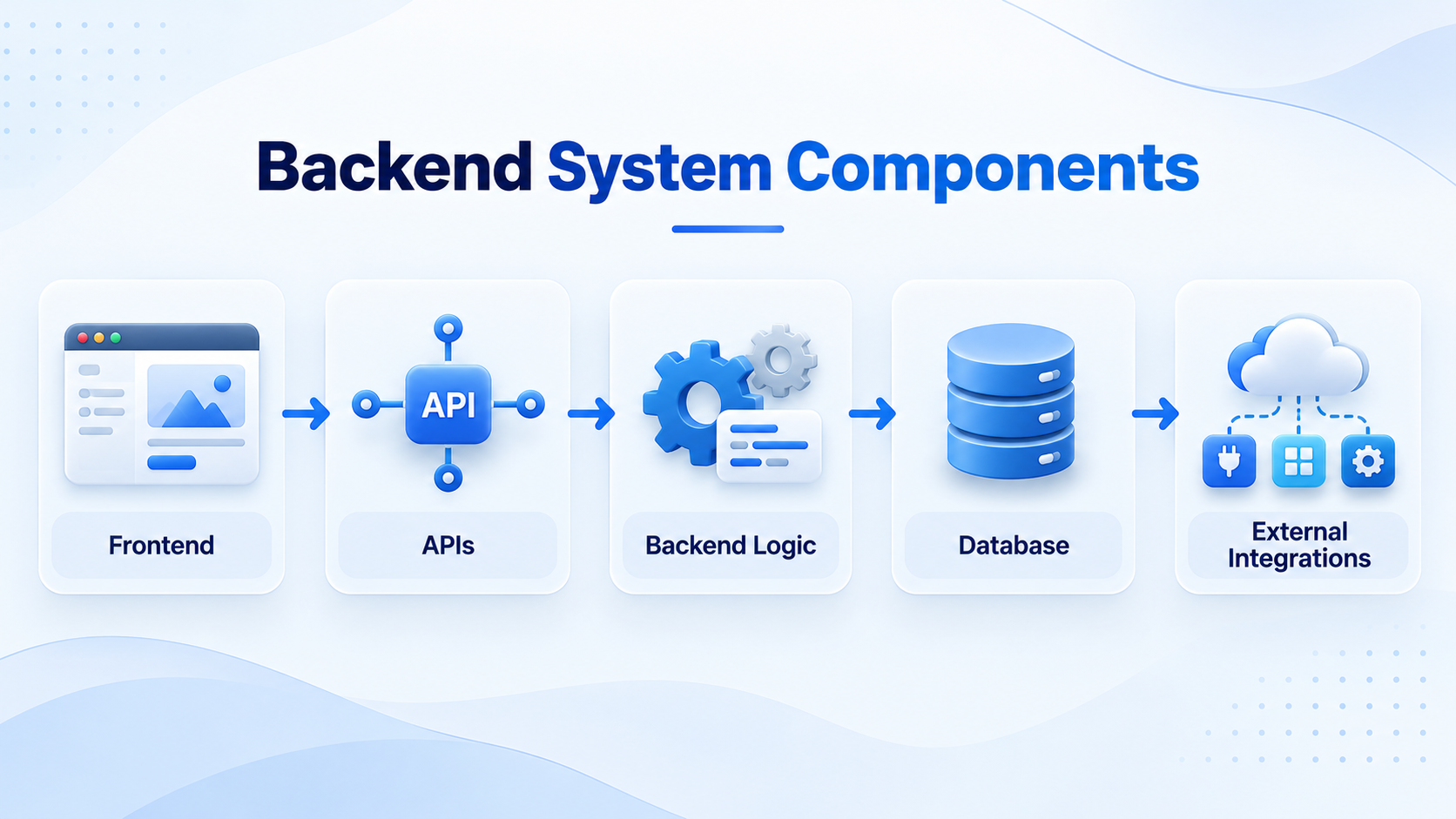
When users interact with a digital platform, whether they are clicking a button on a website, submitting a form, or refreshing a feed on a mobile application, a request is immediately sent to a server. The server receives that request, processes the necessary rules, interacts with a database to retrieve or store information, and sends the correct response back to the user's screen. The construction, optimization, and management of these servers, databases, and application logic fall completely under the umbrella of server-side development services.
Backend development services involve creating the hidden architecture that makes software function. This includes designing highly structured databases, writing complex business logic, configuring server environments, and establishing strict security protocols to protect data in transit.
When a business hires a backend development company, they are bringing in specialized engineers who focus entirely on data management, server architecture, and system integration. These experts ensure that when a customer makes a purchase on an ecommerce site, the inventory updates instantly, the payment processes securely through a gateway, and a confirmation email is generated—all within milliseconds.
When a business hires a backend development company, they are bringing in specialized engineers who focus entirely on data management, server architecture, and system integration. These experts ensure that when a customer makes a purchase on an ecommerce site, the inventory updates instantly, the payment processes securely through a gateway, and a confirmation email is generated—all within milliseconds.
Businesses planning a new application or improving an existing system can explore our backend development services for APIs, databases, integrations, authentication, and application logic.
Backend Technologies Businesses Use
Choosing the right technology stack is a decision that impacts your product for years. Different programming languages and frameworks excel at different tasks.
Node.js
Node.js allows developers to build server-side applications using JavaScript. It is commonly used for APIs, real-time applications, chat systems, dashboards, and services that handle many concurrent network requests. Businesses building JavaScript-based applications may also pair Node.js with frontend technologies such as React. You can review the official capabilities in the Official Node.js Documentation.
Laravel (PHP)
Laravel is a widely used PHP framework for building web applications, APIs, SaaS products, and content management systems. It includes tools for authentication, routing, database operations, queues, and other common backend requirements. The Laravel Documentation highlights how it accelerates project timelines through pre-built structural elements.
Python
Python is widely used for backend applications involving data processing, automation, artificial intelligence, machine learning, and APIs. Frameworks such as Django and FastAPI can support different types of web and data-driven applications.
Java
Java is commonly used for business and enterprise applications that require structured development, long-term maintenance, and established frameworks and libraries. It is often considered for systems with complex workflows and larger development teams.
Cloud Infrastructure
Modern backends no longer live on physical servers in a company basement. Cloud backend development involves hosting infrastructure on platforms like Amazon Web Services (AWS) or Google Cloud. Cloud platforms such as AWS and Google Cloud can be configured to add or reduce computing capacity as application demand changes.
The right backend technology depends on the application rather than the popularity of a framework. Node.js can suit real-time and API-heavy products, Python is widely used for data and AI-related applications, while Java and PHP frameworks are common choices for business and enterprise systems. Architecture decisions should be evaluated separately from the programming language.
Database Technologies Used in Backend Development
Databases are one of the most important components of backend systems because they store, organize, and manage application data. The right database approach depends on the type of application, amount of data, backend performance requirements, and business workflows.
Backend developers commonly work with relational databases such as PostgreSQL and MySQL, as well as NoSQL databases such as MongoDB for applications requiring flexible data structures.
Businesses should consider factors such as data security, reporting requirements, integrations, and future maintenance when selecting a database technology.
| Database Type | Suitable For |
|---|---|
| PostgreSQL | Business applications requiring structured data management |
| MySQL | Websites, web applications, and business platforms |
| MongoDB | Applications requiring flexible data structures |
Modular Monolith vs Microservices Backend Architecture
Choosing a backend architecture is separate from choosing a programming language or database. A modular monolith keeps application components within one deployment while maintaining clear internal boundaries. Microservices separate parts of an application into independently managed services.
| Factor | Modular Monolith | Microservices |
|---|---|---|
| Deployment | One application | Multiple independent services |
| Initial complexity | Lower | Higher |
| Infrastructure | Simpler | More components to manage |
| Team coordination | Easier for smaller teams | Useful when different teams manage separate services |
| Best fit | Many new and mid-size products | Systems with clearly separated service requirements |
Businesses should choose between these approaches based on product requirements, team structure, deployment needs, maintenance effort, and system complexity rather than assuming microservices are always the better option.
Backend Development Trends Businesses Should Consider in 2026
Backend systems are becoming more focused on reliability, security, and better integration between different platforms. Businesses planning new applications should consider:
API-First Development
Businesses increasingly design applications around APIs to improve communication between web applications, mobile apps, and external platforms.
Cloud-Based Infrastructure
Cloud platforms help businesses deploy applications, manage infrastructure, and monitor performance more efficiently.
Stronger Security Practices
Security-focused backend development includes authentication, access control, encryption, and regular testing.
Better Integration Capabilities
Modern applications often depend on multiple third-party services, making integration planning an important part of backend development.
Why Businesses Need Backend Development
Businesses often spend significant time on the visible parts of an application, but backend systems are equally important. Problems with backend architecture, database design, security, or integrations can affect application performance, reliability, and the way business processes operate.
Professional backend application development services can support several important areas of a digital product:
- Centralized Data Management: A strong backend allows you to serve data to multiple platforms simultaneously. For example, a single database can power a web dashboard, an iOS app, and an Android app, ensuring that information is always synchronized across all user touchpoints.
- Advanced Security: Backend security practices can help protect user data, passwords, and payment information through authentication, access controls, encryption, secure APIs, and regular testing.
- Business Logic Execution: The backend holds the specific operational rules that make your business unique. It calculates localized taxes during checkout, determines user access levels based on subscription tiers, and triggers automated administrative workflows without human intervention.
Real-World Examples of Backend Reliance:
SaaS Platforms
Require complex multi-tenant databases to separate data securely for different corporate clients, alongside automated subscription billing logic and usage-tracking algorithms.
Healthcare Applications
Backend systems can support secure patient records, access controls, data exchange, and healthcare workflows where privacy and regulatory requirements such as HIPAA need to be considered.
A U.S. healthcare platform shows how backend systems can bring patient data, AI-assisted workflows, secure access, and real-time communication into one application, helping medical teams and patients work with information through a connected system.
See The Healthcare Application Case Study →Ecommerce Systems
Need advanced database development services to sync live inventory across multiple warehouses while processing hundreds of concurrent payment requests during major sales events.
FinTech Applications
Rely on high-speed transaction processing engines and complex fraud-detection algorithms that run entirely on the server side to protect financial assets.
Enterprise Dashboards
Pull data from dozens of internal company tools (such as HR software, financial ledgers, and logistics trackers) into one centralized reporting database for executive decision-making.
A U.S. event management platform shows how a backend can bring bookings, vendor management, payments, schedules, and communication into one system instead of managing these workflows separately.
See The Event Platform Case Study →Types of Backend Development Services
Because business requirements vary widely, a backend software development company will typically offer several distinct categories of service.
Custom Backend Development
Custom backend development services focus on creating backend systems around specific business workflows, application requirements, data structures, and integrations. Developers may use existing frameworks, databases, cloud services, and libraries while building the architecture and business logic required for the product.
Backend API Development
An API (Application Programming Interface) allows different software systems to exchange information. Backend API development services include creating endpoints for web applications, mobile apps, internal tools, and third-party platforms. This may include REST APIs, private APIs, authentication, error handling, and connections with services such as payment gateways or CRM platforms.
Backend API Integration and Third-Party Systems
Backend integration solutions connect applications with payment gateways, CRM systems, communication tools, analytics platforms, and other third-party services. Before development begins, teams should define authentication methods, data formats, error handling, API limits, and what should happen when an external service becomes temporarily unavailable.
Backend Web Development
Websites that require user logins, dynamic content generation, or complex databases rely heavily on backend web development services. Backend web app development services can also support SaaS platforms, customer portals, dashboards, and other browser-based applications that depend on server-side functionality. A backend web development agency can handle server configuration, database connections, authentication, APIs, and other server-side requirements for web applications.
Backend Application Development
Mobile and web applications often require backend systems for authentication, user data, notifications, file storage, synchronization, APIs, and third-party integrations. Backend app development services create the databases, APIs, and server-side functionality that support these features and connect the application with other systems.
A backend app development company may also help plan how these systems connect with mobile, web, and third-party platforms. Businesses building mobile applications may combine backend development with mobile app development services so that frontend and server-side requirements are planned together.
Backend Security Considerations
Backend systems manage important business data, user information, and application functionality. Security should be considered during backend planning and development to protect applications from unauthorized access and data risks.
A well-built backend security approach includes:
Authentication and Access Control
Authentication verifies user identities, while access controls ensure users can only access the information and features they are authorized to use.
API Security
APIs connect different applications and services, making secure API design important for protecting data exchange between systems.
Data Protection
Backend systems should follow secure practices for storing, processing, and transferring sensitive information.
Security Testing
Regular security testing helps identify vulnerabilities and improve the reliability of backend applications.
Backend Development Process
Backend development usually follows a structured process that helps teams define requirements, plan architecture, build APIs and databases, test the system, deploy it, and provide ongoing support.
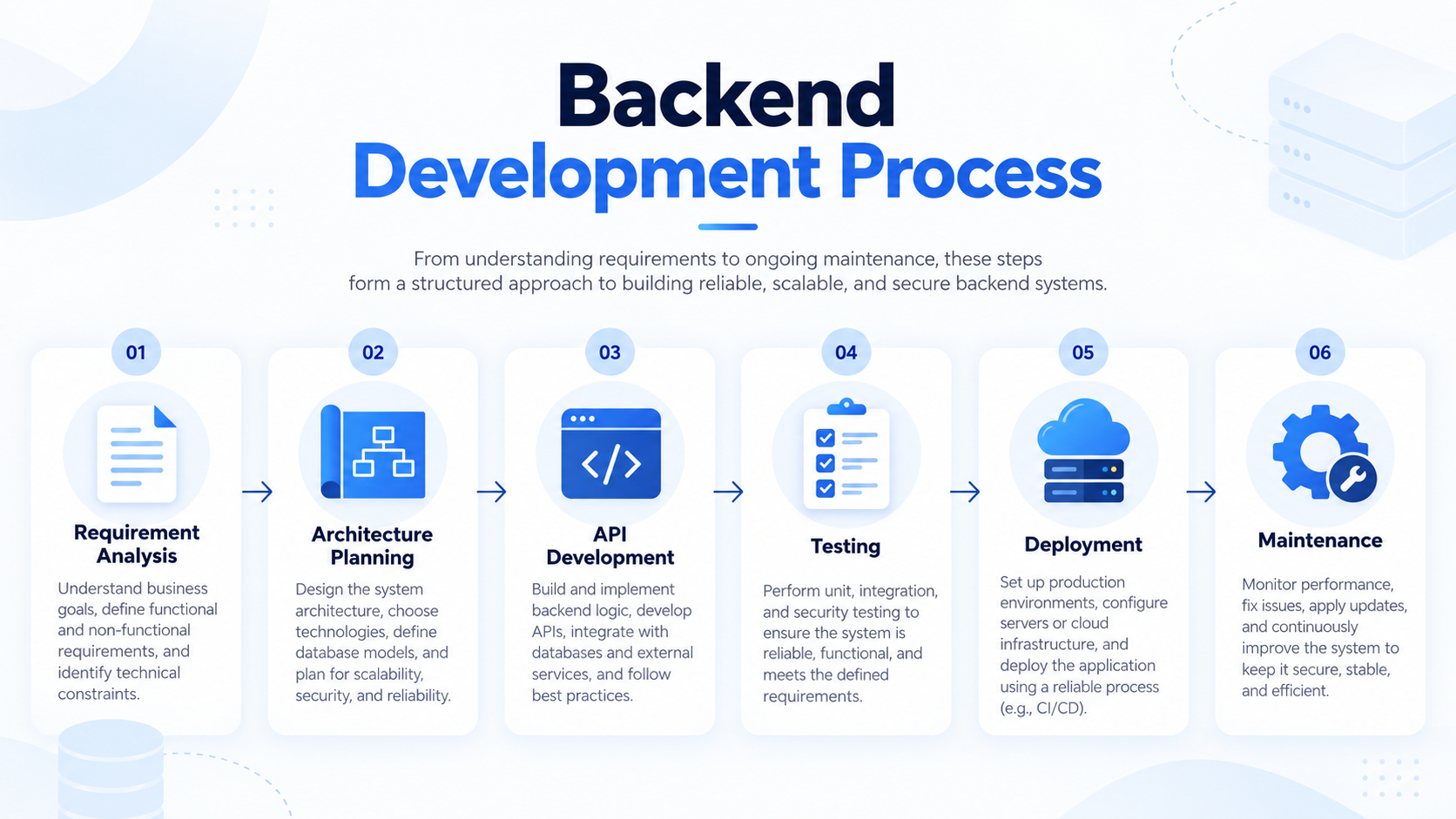
- Requirement Analysis: The team documents your business rules, user roles, and data storage needs.
- Architecture Planning: Engineers design the database structure and map out how data will move through the system.
- API Development: Developers write the code that allows the frontend to communicate with the server.
- Testing: Quality assurance teams test functionality, performance, integrations, security controls, and potential data issues.
- Deployment: The code is pushed to a live server environment, configuring domains and SSL certificates.
- Maintenance: Continuous monitoring for errors and applying security patches via backend maintenance services.
Backend Maintenance, Monitoring and Reliability
Backend development does not end at deployment. Backend maintenance services can include monitoring, security updates, performance checks, error tracking, and ongoing fixes as application requirements change. Teams should also watch failed integrations, database issues, timeouts, retries, and API limits so problems can be identified and addressed early.
Backend Development Checklist Before Starting a Project
To help businesses prepare, we have created a standardized checklist to review before hiring developers:
| Area | Questions to Answer |
|---|---|
| Architecture | Is the backend structure planned? What cloud provider will host it? |
| Database | Is data management defined? Are you using relational or NoSQL databases? |
| APIs | Are external integrations identified? (e.g., Stripe, Twilio, Salesforce) |
| Security | Are authentication requirements clear? Is two-factor authentication required? |
| Deployment | Is the hosting strategy planned? Who will manage server environments? |
How Much Does Backend Development Cost?
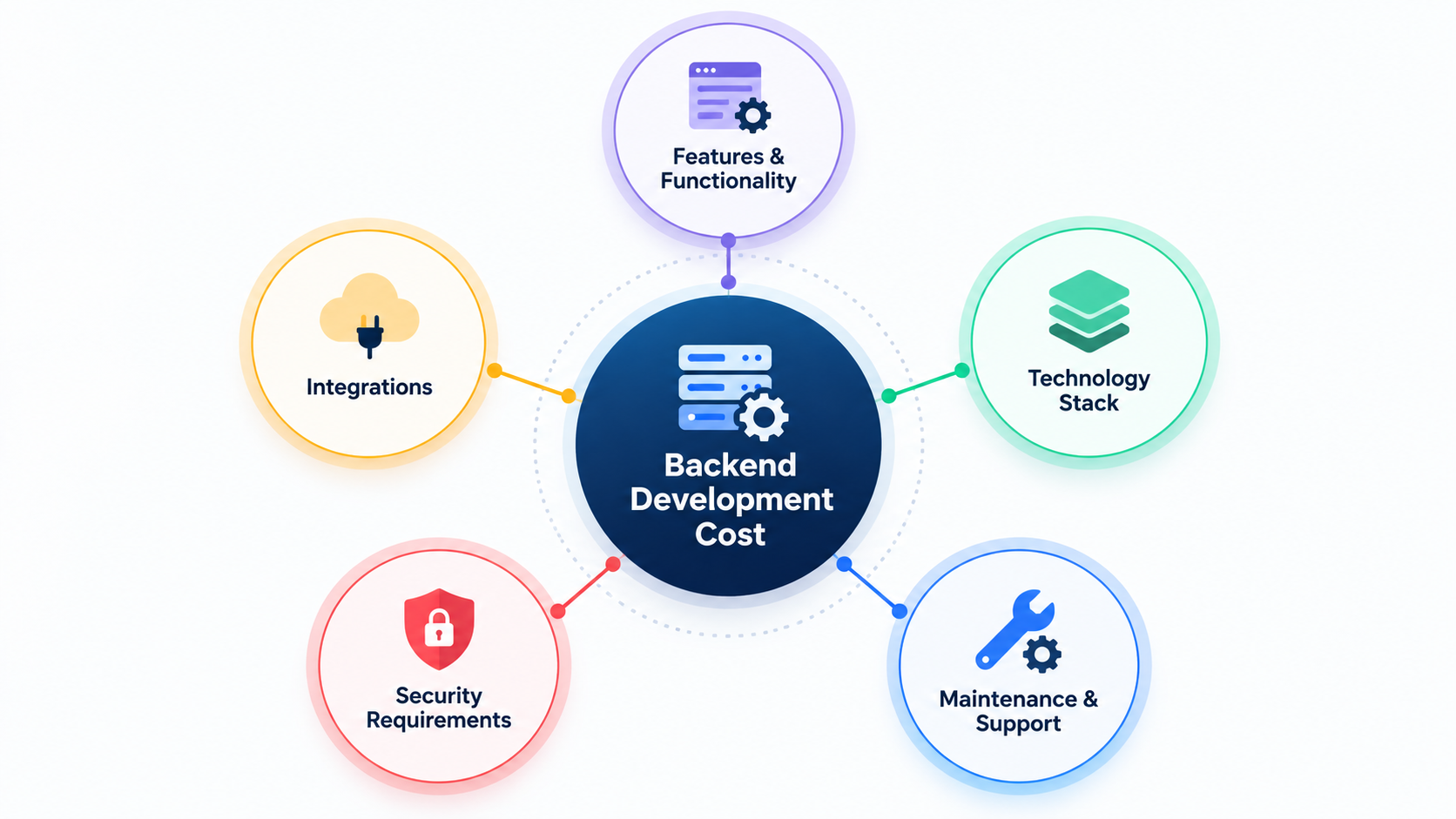
One of the most common questions from business leaders is, "How much does backend development cost?" Backend development pricing depends on factors such as business logic, application complexity, data requirements, integrations, security, and infrastructure.
Understanding backend development cost requires breaking down the product into different tiers. A simple database costs significantly less than a custom machine-learning engine.
How APIs Affect Backend Development Cost
API requirements can affect backend development cost when a project involves several external platforms, custom authentication, data transformation, testing, or error handling. API development cost also depends on whether the team is creating new endpoints or connecting an application with existing third-party services.
Cost Breakdown by Project Complexity
| Project Type | Factors Affecting Cost | Expected Scope |
|---|---|---|
| MVP Backend | Basic APIs, standard database, simple user authentication. | Designed to prove a concept with minimal initial users. |
| SaaS Backend | Multi-user systems, admin dashboards, subscription payment integrations. | Built to support distinct client accounts and ongoing billing. |
| Enterprise Backend | Complex workflows, strict security compliance, legacy system integrations. | Designed for systems with complex workflows, security requirements, integrations, and higher operational demands. |
How Long Does Backend Development Take?
Backend development timelines depend on the application's complexity, required features, integrations, technology choices, and testing requirements.
A simple backend system with basic APIs and authentication may require less development time, while SaaS platforms and enterprise applications usually require more planning because they involve multiple users, workflows, integrations, and security requirements.
| Project Type | Timeline Factors |
|---|---|
| MVP Backend | Core APIs, database setup, authentication |
| SaaS Backend | User management, subscriptions, dashboards, integrations |
| Enterprise Backend | Complex workflows, security requirements, multiple systems |
When budgeting for a backend project, businesses should consider three primary expenses:
| Decision factor | All-in-one platform | Modular stack |
|---|---|---|
| Speed to a standard pilot | Usually faster | Fast when the scope is narrow and proven components are used |
| Workflow customization | Limited to platform capabilities | Strong control over patient, provider, and admin experience |
| EHR strategy | Depends on supported connectors | Can use an integration layer tailored to target systems |
| Source-code ownership | Usually limited | Core application can remain owned by the business |
| Vendor lock-in | Higher when multiple workflows depend on one platform | Lower when adapters and export tests are designed well |
| Operational responsibility | Fewer vendors, but still a shared-responsibility model | More integration and monitoring responsibility |
| Long-term flexibility | Good for standard service models | Better for differentiated or evolving care workflows |
- Initial Development: The hourly or fixed-project cost to write the code and design the database.
- Third-Party Services: Monthly fees for cloud hosting (AWS, Azure), payment processors, and external APIs. For database management specifically, tools like PostgreSQL offer open-source solutions that help control software licensing costs.
- Ongoing Maintenance: Budgeting for regular updates, server monitoring, and security patching.
If you choose backend development outsourcing, costs will also vary based on geographic location, though quality and communication should always remain the top priorities.
How To Choose A Backend Development Company
Choosing the right backend development agency or company means looking beyond technical skills to project experience, communication, security practices, and post-launch support. A reliable partner does more than write code; they help businesses plan architecture, select suitable technologies, develop secure APIs, manage databases, and support applications after launch.
When evaluating a backend development company, businesses should look beyond pricing and consider technical expertise, previous experience, security practices, communication processes, and long-term support capabilities.
What To Look For In A Backend Development Partner
A suitable backend development partner should have:
- Experience building similar applications and backend systems
- Strong knowledge of APIs, databases, and integrations
- Clear development and communication processes
- Security-focused development practices
- Post-launch maintenance and support capabilities
Relevant case studies can also help businesses understand whether a company has experience with similar applications, integrations, industries, and technical requirements.
Backend Development Company vs Hiring Developers vs Freelancers
Businesses can hire backend developers internally, work with freelancers or a backend development company, or use an extended development team. The right approach depends on project scope, internal expertise, timeline, and the level of ongoing support required. Businesses that need both frontend and backend expertise may also work with full-stack developers.
| Option | Best For | Pros & Cons |
|---|---|---|
| In-house Team | Companies with existing, large internal engineering teams. | High control, but expensive and slow to recruit. |
| Freelancers | Small, short-term tasks or minor bug fixes. | Flexible for focused tasks; larger projects may require additional specialists and coordination. |
| Backend Development Company | Businesses needing complete, end-to-end technical expertise. | Can provide multiple technical roles, project coordination, testing, and ongoing support. |
| Extended Development Team | Companies needing to quickly add additional engineering capacity. | Adds technical capacity without full-time recruitment; requires clear coordination with the internal team. |
Conclusion
Backend development decisions affect how an application manages data, integrations, security, performance, and future changes. For U.S. businesses planning a new application or improving an existing one, choosing suitable technologies, architecture, and ongoing maintenance can provide a stronger foundation for web applications, mobile apps, SaaS products, and enterprise systems.
Frequently Asked Questions (FAQs)
Starting a new project or
want to collaborate with us?